

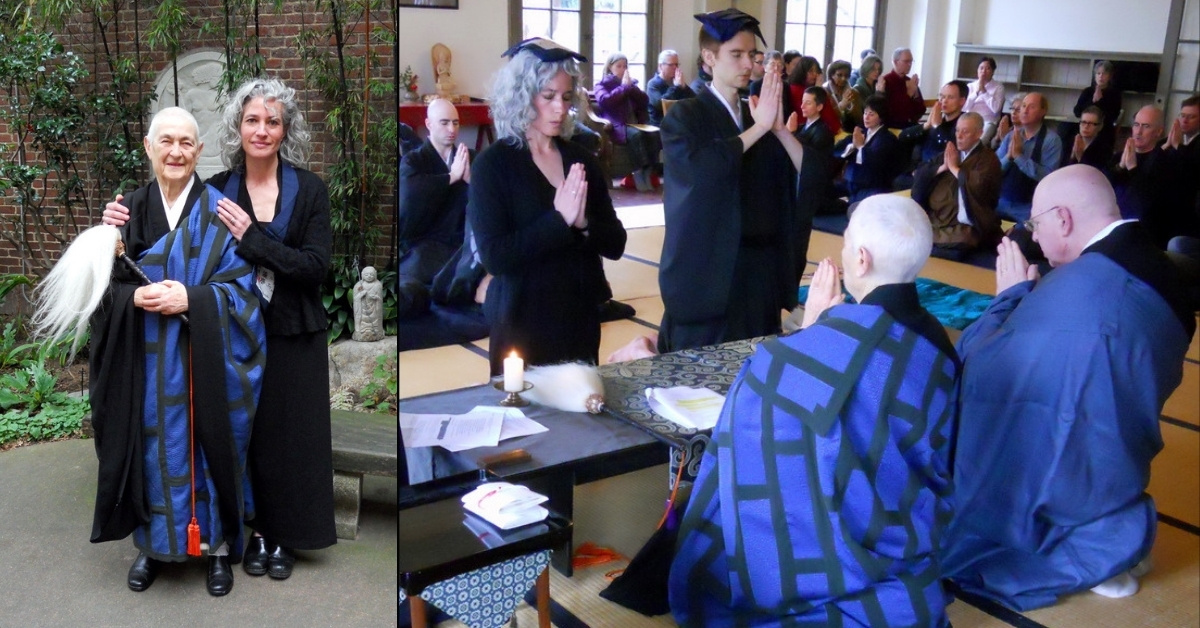
Zenkei Blanche Hartman wearing the special ceremonial robe. She is pictured with her student Kate Frankfurt. Photos by Renshin Bunce.
Note: In February of 2009, Sangha News Journal posted this article by Ryuko Laura Burges on the occasion of Blanche receiving a special ceremonial robe sewn collectively by over 125 people from all over the world. We are sharing it again today in memory of her passing over 10 years ago in 2016.
There is also a short video on YouTube featuring images of this robe as well as Blanche in the SFZC sewing room talking about it.
By Laura Burges
Images from Renshin Bunce
“When I realized years later that at Zen Center I had become identified with the most traditional of women’s activities, I thought of it as a stunning karmic joke.”
—Zenkei Blanche Hartman
Zenkei Blanche Hartman, a former Abbess of San Francisco Zen Center, has been for many years our primary sewing instructor, helping people sew their rakusus and okesas, our Buddhist vestments, in preparation for ordination. This is the ceremony where a practitioner receives the precepts and a Buddhist name from his or her teacher. Blanche has trained many others to carry on this practice and her devotion to this Way has benefited sanghas as far flung as Texas, Utah, North Carolina, Illinois, Oregon, and, of course, all around the Bay Area.
When asked how she came to be so deeply aligned with this activity she replied, “It was, in a word, improbable. I wasn’t very good at sewing when I started. I remember in 7th grade having trouble putting sleeves in a dress in my home economics class. This was during the Depression and my teacher, Violet Tyler, said to me, ‘Our next project is to make a garment out of wool. Wool is a lot more expensive than cotton and I don’t think you should try it. Could you please refinish all the sewing machines instead?’”
Blanche had “made quite a fuss about being able to take woodshop,” so she knew how to do that and got an A in sewing despite her less than exemplary sewing skills.
In 1970, Yoshida Roshi, Abbess of Kaizenji Monastery in Nagoya, Japan, came to visit San Francisco Zen Center. Suzuki Roshi had sent Joyce Browning to Kaizenji and her husband, Ron, to Eiheiji for training and Yoshida Roshi was very curious to see where Joyce had come from. She found seven priests here wearing “store bought” robes and she encouraged Suzuki Roshi to have SFZC take up the practice of Nyoho-e, or “clothing made according to the Dharma.” This was a movement in Japan that took hold during the 20th Century, when monks returned to sewing robes in the way they had during Buddha’s time. Yoshida Roshi offered to do a sewing sesshin so that ordained people could learn how to sew robes in this traditional way.
“At that time, it was actually the wives and girlfriends who did most of the sewing,” Blanche added wryly.
Virginia and Richard Baker were living in Japan at the time and Yoshida Roshi suggested that Virginia study sewing with Joshin-san Kasai, a nun at Antaiji Monastery. After Suzuki Roshi’s death, Richard invited Joshin-san to come to SFZC to help instill a sewing practice here.
When Blanche came to SFZC, Pat Herreshoff, who died recently at the age of 95, was Suzuki Roshi’s jisha, or attendant. She had studied in Japan and spoke Japanese, and she translated the sewing instructions into English.
“Then Joshin-san had them translated back into Japanese to make sure Pat had gotten them right!” Blanche said. When Joshin-san came back to Zen Center for a second visit, Blanche went to Tassajara, helping Joshin-san and sewing her own first rakusu.
“I didn’t sew very well, but because of my experience with carpentry, I understood things like ‘parallel’ and ‘perpendicular’ and ‘measure twice and cut once.’ I began to understand how the pieces come together. When I was done with my rakusu, Joshin-san showed it to Baker Roshi and from then on, I was her assistant. She was such a bright, lively person. As Ann Overton once said when speaking of Joshin-san, if she had repaired televisions, I would have learned how to do that, because I just wanted to hang out with her. I was so moved by her devotion to this practice.”
Joshin-san spoke Japanese to Blanche and Blanche spoke English to Joshin-san but somehow they understood one another, sometimes with the help of a translator.
Blanche recalls an antique dealer who collected old okesas who wanted to meet Joshin-san and learn how to repair and conserve them. When the two were introduced, there was a great outburst of Japanese and Kaz Tanahashi translated Joshin-san’s words: “Any okesa is the whole body of Buddha! Why would anyone want a collection!”
Jean Selkirk, of Berkeley Zen Center, has said of Blanche, “Her warm-heartedness is felt in every instruction she gives, and softens the times when inevitable mistakes occur. Definitely these happen in the course of learning the many intricate steps involved in teaching sewing. Unfailingly, Blanche points out how she might do it without leaving a sense that anything is truly amiss. Then it’s time to try again and see if learning the process has moved forward. Yet when an oversight takes place, and an about face is needed, and the day becomes long and we’re all becoming a little tired, her sense of humor, even a song, or story about her own foibles provide release in laughter and we can return to making our best effort on each moment.”
Last year, Jean Selkirk and Yuko Okumura helped organize about 125 people from around the world to stitch a special okesa for Blanche. This kind of collective sewing is called, in Japanese, a fukudenkai, from the word fukudenei in our robe chant, and it means “a formless field of happiness.” The work was done in the Funzoe style, robes made from discarded fabric or rags. This stems from the ancient tradition of monks finding old cloth that was considered unclean, washing, dying, and sewing it. The fabric was blue silk that had belonged to Yuko Okamura’s mother and was passed on for the project. The okesa was made of 21 panels totaling 105 pieces to wish Blanche a long life to come. The okesa was presented to Blanche by Sojun Mel Weitsman on July 13, 2008.
“Each person’s stitching is unique, like handwriting,” Blanche remarked as she described this special okesa. The royal blue robes that were made for her by these devoted stitchers, when spread out over worktables in the Wheelwright Center at Green Gulch, looked like a shimmering ocean. “An ocean of love,” as Blanche put it.
When asked how her long history of sewing has affected her life, Blanche says, “It’s a wonderful way to be with people as they are getting ready to receive the precepts and join the lineage. I’ve loved this way of engaging with people on their way to ordination.”
Tim Wicks studies sewing with Blanche and spends many hours at City Center helping students sew. He says, “While sewing Buddha’s robe we take refuge in the Buddha with each stitch. Blanche prefers people to use the Japanese, which is somewhat more dramatic than the comparatively mundane English, ‘I take refuge in the Buddha.’ The Japanese, ‘Namu kie butsu’ means, ‘I, without reservation or hesitation, take refuge in the Buddha.’ As I had the chance to be around Blanche weekly in the close proximity of the sewing room, I soon saw that it was the transformation of others, using any means necessary, that Blanche, like a true bodhisattva, was interested in.”
Renshin Bunce has been sewing with Blanche since 1996. “Once we were eating dinner at the same table in the dining room and the conversation was about sewing. I heard Blanche say to someone, regarding my emerging role as a sewing teacher, ‘I’m trying to clone myself.’ It took me some time to understand that this was not about her and not about me. It reflects her devotion to Joshin-san and Suzuki Roshi.
“As Blanche has carried the sewing tradition for decades and has cheerfully helped hundreds of people sew rakusus and okesas, she’s looking for people who can carry Joshin-san’s teaching into the future. As Joshin-san instilled in her this ancient practice, so Blanche aims to continue to instill this practice in us, with her knowledge and her attitude, her sweetness, as we gather and endlessly chant, ‘Namu Kie Butsu.” I can hear her voice now, tirelessly explaining to another beginner, ‘I like to think of it as ‘I plunge into Buddha.’”
Cover from her funeral service program in 2016 (PDF)
Ryuko Laura Burges, a lay entrusted dharma teacher in the Soto Zen tradition, lectures and leads retreats at practice centers in Northern California. Laura co-founded the Meditation and Recovery program at San Francisco Zen Center. She is the author of several books with Shambhala Publications, including Buddhist Stories for Kids and The Zen Way of Recovery.


0 Comments