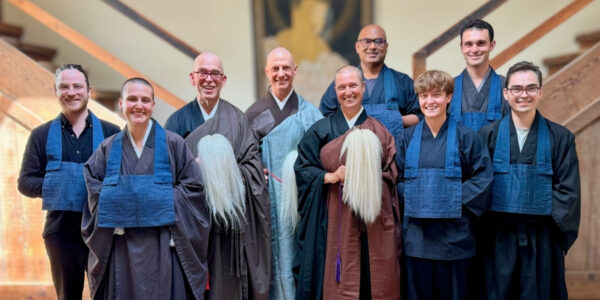

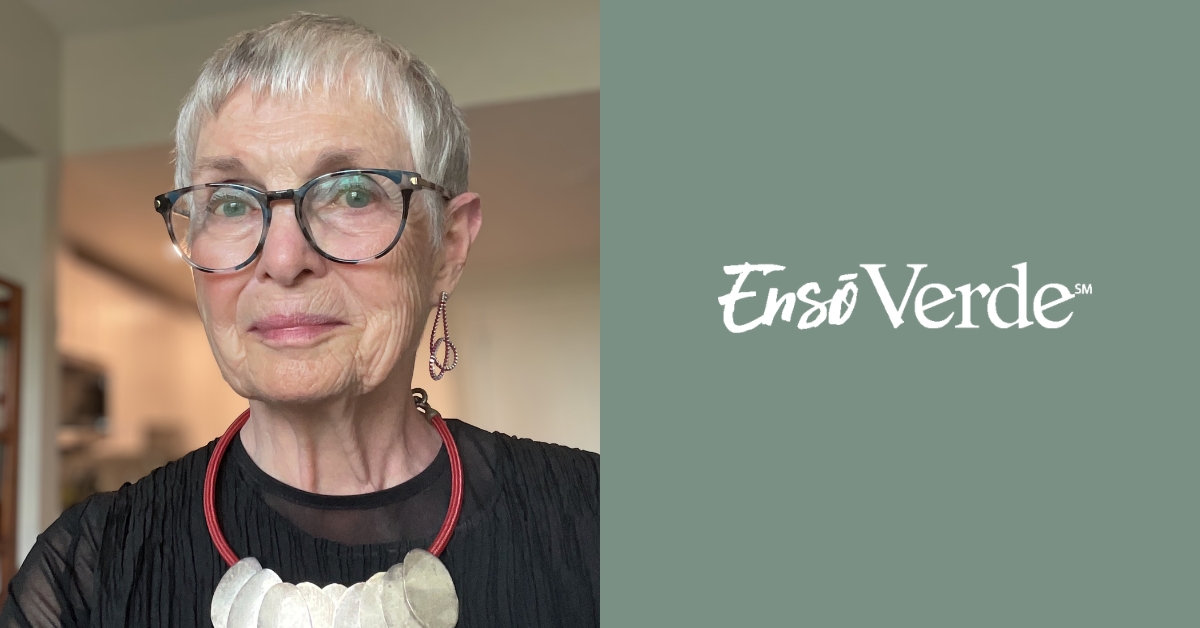
Sangha News Journal sat down with Susan O’Connell, a SFZC priest and founder of Zen-Inspired Senior Living which has created Enso Village, a retirement community in Healdsburg, CA and its sister community, Enso Verde in Simi Valley, CA. She was one of the first people to move into Enso VIllage almost three years ago. Here she looks back at the founding of this groundbreaking approach to aging, also called Conscious Aging, and what it takes to expand this concept out into the world.
Hello Susan and welcome. Thank you for talking with us today. Let’s start at the beginning. How did all of this come to be?
Around 2015-16, San Francisco Zen Center created a small affiliated entity called Zen-Inspired Senior Living (ZISL) out of the need for us to house and care for our senior teachers. We created a new paradigm for senior living, expanding our mission from just taking care of our own teachers to sharing this way of living with the wider world. A world with a generation of people that is ready for a new way, a generation who came out of an initial interest in consciousness. The response to Enso Village was so strong that we sold out in record time. In the senior living world, we’re actually kind of famous, like rock stars (laughs)!
Since there’s nothing else like this in the senior living realm and we knew that there are many more people who could benefit from this, we kept our feelers out for another location. A few years ago we were shown a beautiful piece of land in Southern California that just naturally felt like a retreat center. It was another example of SFZC’s excellent land karma!
Land karma?
SFZC has some of the most beautiful places in the world: Tassajara in the Ventana Wilderness. Downtown San Francisco in a Julian Morgan building with a campus of five buildings. Green Gulch Farm in Marin. Enso Village in Healdsburg, and now this new property, Enso Verde. So to me this is like the universe is saying: here you go, here’s a spot for you to make this offering. We don’t own the Enso properties, of course, but still, we are able to be a part of making something wonderful there.
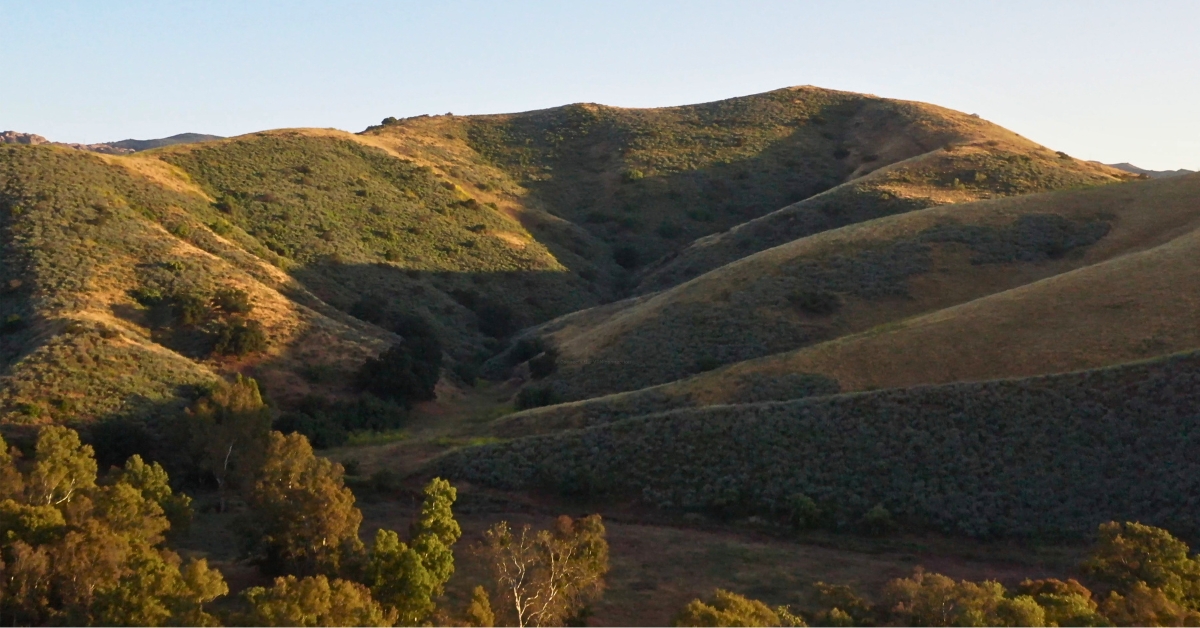
The future home of Enso Verde in Simi Valley, CA
So this parcel of land was the beginning of Enso Verde, right? Can you say more about it?
Enso Verde is on this beautiful piece of land in Ventura County, in Southern California, up against the mountains in Simi Valley. It’s surrounded by 2,800 acres of open space and it’s a 20 acre site with a dry creek running through the middle. It’s never been built on. It’s gorgeous. It feels like a retreat center, very quiet and serene. And yet, if you want to get to downtown LA, there’s an Amtrak two miles away. You hop on that and you’re downtown in 35 and 40 minutes. Or you can get to Burbank Airport in 30 minutes. So it’s isolated from the hustle bustle and the traffic of LA, but you have access to all of the great things that LA has to offer.
Los Angeles is a huge territory, over 8 million people and our challenge is how are we going to find people who would be attracted to this? San Francisco Zen Center is known internationally, but a little bit less known in Southern California than in Northern California. A lot of our success with Enso Village was that people knew SFZC and knew they could trust us.
How are you working with that?
So one thing we’re doing is talking about Enso Verde more in the realm of mindfulness, as opposed to just Zen or Buddhism. We are talking specifically about mindful awareness, mindful aging, which is a word that is very well known by the people who would be attracted to living in this way.
In many ways, Enso Verde is set up a lot like Enso Village, with retired spiritual teachers and leaders living amongst people who want to live this way, too. One small change is the teachers will be from various contemplative traditions. We have someone right now who is a Unitarian minister and a Zen teacher. We have a couple of Buddhist teachers but we are also looking for a yoga teacher who has taught contemplative yoga. We would love to have a rabbi. And so on.
So we start from using the word Zen more lightly, but not changing the basic guiding principles and offerings. There will still be a kitchen garden, a meditation hall, a head of spiritual practice, Mindful Community training for residents and staff—all of those elements that we have at Enso Village, will also be at Enso Verde.
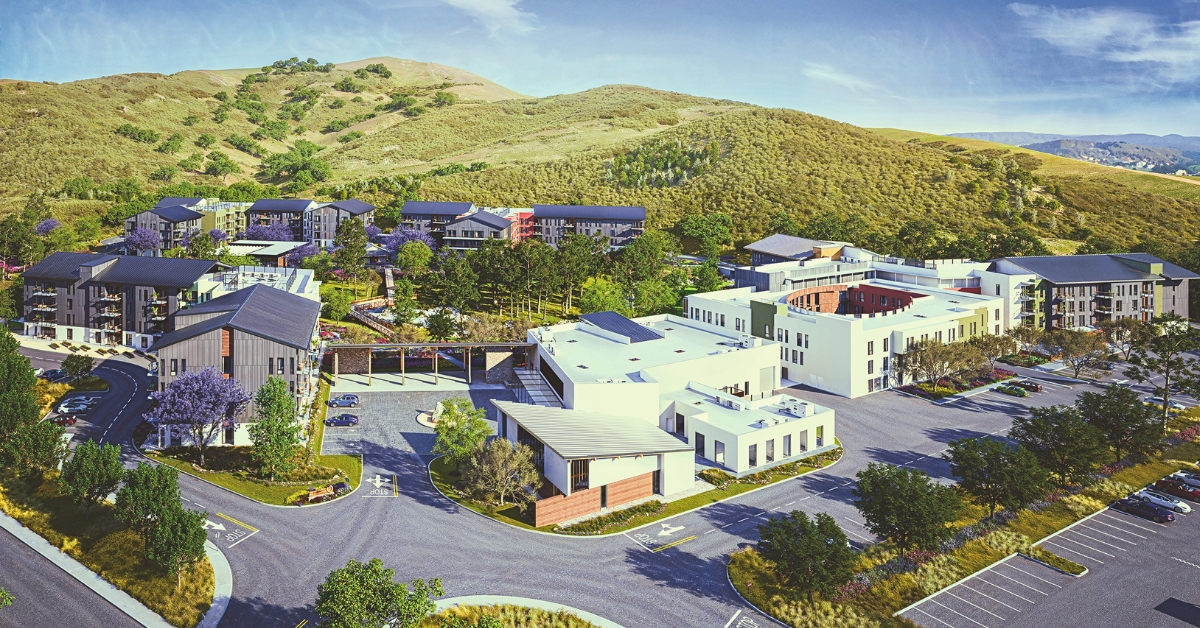
Rendering of the Enso Verde campus
We’re applying things we’ve learned from Enso Village. The architects are coming up to Enso Village next week to do another walkthrough of the lobby and kitchen area to see what we can learn about flow and sound and things like that. So Enso Verde will benefit from us having done this once already.
How’s it going so far? Are people signing up?
At this point, we’re 56% reserved. So we’re reaching people, we are talking to people. We did a little video that Peter Coyote narrated—he was very happy to help out in that way. And we have teachers from other Buddhist traditions moving in. So for instance, Jack Kornfield and his wife Trudy Goodman from Spirit Rock just signed up, they just did a wonderful interview for our newsletter for the depositors.
When do you think Enso Verde will be open?
We hope to start construction in the spring of 2027. We’ll have all of our pre-sales done by then and we should have all of the permits from the city, etc. And then it takes a couple years of construction, so we’re looking at 2029.
Let’s dive a little deeper into Zen-Inspired Senior Living. What does ‘Zen-Inspired’ mean and what does it look like?
When we talk about Zen-Inspired Senior Living (ZISL), there are two aspects to consider. One is the physical environment and how we provide spaces for contemplative practices. The other is how we tend to our inner life, our spiritual life, and our wellbeing as we age. I also refer to this as Conscious Aging.
The physical environment contains things like a meditation hall, a place to meet with the teacher to have a conversation about your life and practice, a kitchen garden that’s directly related to the kitchen itself, so that we’re in the midst of appreciating food and understanding where our food comes from.
It involves having a spiritual director and someone who is monitoring the meditation hall so that programs are provided and the presence of practice is provided.
Presence of practice?
Living amongst people with an established spiritual practice, experienced teachers who have trained in and taught contemplative practices all of their lives. So a presence of wisdom.
It also involves the option of taking this training that we developed from our understanding of hospice and being with dying. We call it Mindful Community Training. It’s what it means to live in community with each other and do this aging thing together. We offer it to any resident who wants to take it. At Enso Village, over 150 people have participated. We also require it for the staff, so that the staff has a similar understanding of what it means to be present, what it means to be compassionate, what it means to deal with loss all the time. How to do that, and also what it means to set appropriate healthy boundaries.
On top of that, there are a set of principles, guiding principles, which are also about what it means to live together in community, which we bring from our many years of living together at SFZC. It basically means not turning away. So here’s the definition:
“Conscious Aging is the intentional practice of growing older with awareness, purpose, and self-compassion. It involves accepting the realities of aging while actively nurturing physical health, emotional resilience, mental clarity, and spiritual well-being. Rather than resisting change, conscious aging invites people to reflect on their values, adapt to new stages of life, deepen relationships, and find meaning in both limitations and possibilities. It invites us to see aging not as a loss, but as a deepening. The process emphasizes mindfulness, lifelong learning, gratitude, a willingness to evolve, helping individuals approach aging not as decline alone, but as an opportunity for wisdom, compassion, connection, and personal growth.”
So we’re very directly looking at our fears and concerns, the same thing we do in meditation practice. Whatever arises, we meet it. Reb [Anderson] used to always say this, which I love: Our practice is meeting whatever comes with no complaints whatsoever.
“Thank you very much. I have no complaints.”
And what happens when we do this, in my experience, when we stop resisting what is, we have much more energy to engage with our actual life, not our wishful life that isn’t here right now. So it’s practical in that way.
Ultimately when we say Zen-inspired, some people get hung up on the word Zen. Of course, some people love it but others aren’t that keen on Zen, whatever it means to them. But what it’s really about is wisdom and compassion. The wisdom to understand that everything changes and that we’re all connected, and compassion is knowing that we’re all in this together.
People like to talk about living in multi-age communities which is fine, of course. But when you’re in a community where everyone’s going through the same thing, you are really learning from each other all the time.
I see it as another application of how SFZC has historically responded to what the world is asking for. With Greens Restaurant and Green Gulch Farm we were responding to a need for a more healthy food system, a more enjoyable and delicious way of nourishing ourselves.
It was the same thing with Hospice (now Zen Caregivers Project). People started coming to Zen Center during the AIDS crisis saying, “We want to die with you.” Well, what do you do with such a request? We figured out how to set up a hospice; we taught ourselves how to be hospice volunteers. We taught ourselves and then we taught others. It was an offshoot of our practice, an indication that we’re aware of what’s going on in the world, and that we have a new way, a creative way, of meeting those challenges.
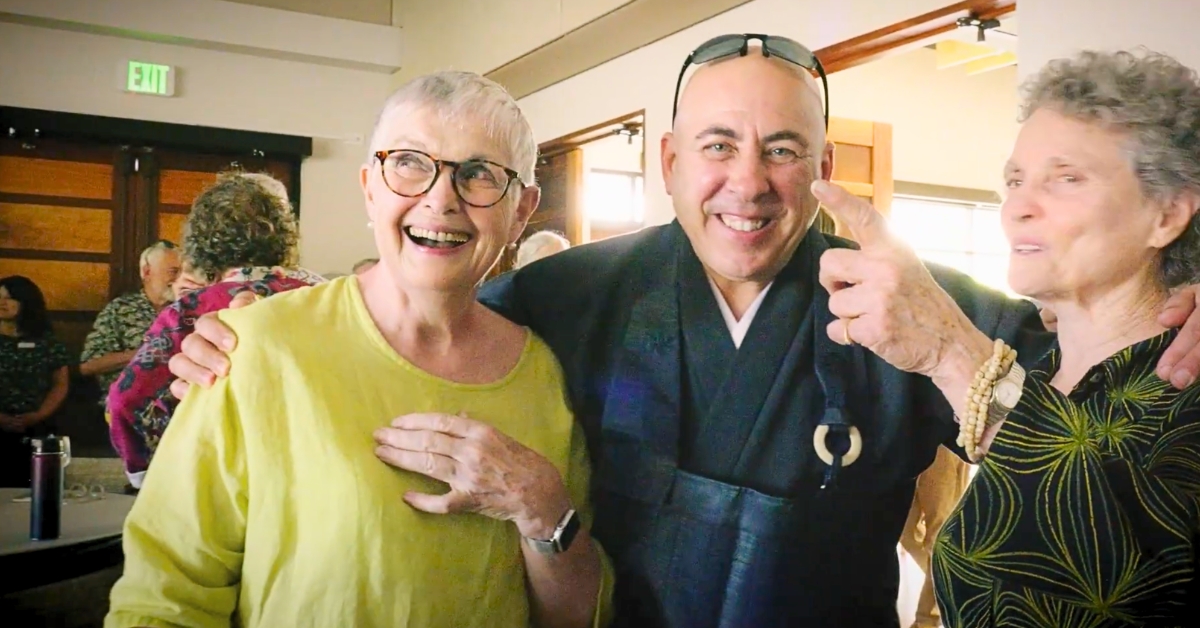
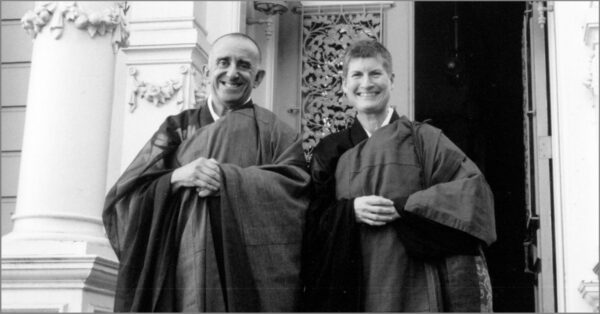
Pictured left to right: Susan O’Connell, SFZC Central Abbot David Zimmerman, Enso Village resident Teah Strozer
You were one of the first people to move in and so you’ve had three years of involvement and engagement. What do you see at Enso Village so far?
I’ve got a couple of different filters for what I see. First I see community evolution. So, starting with the pioneers and the people very enthusiastic about forming the community, there is a lot of enthusiasm, a lot of participation, a lot of ownership and setting up the policies and the processes to reflect our guiding principles. We don’t want cookie cutter corporate stuff. We want stuff that really, really emphasizes compassion. So that’s going on in a kind of a normal way.
However, there’s another filter, which is my theory that the people who responded to these ideas are bodhisattvas. Whether they actually know it consciously or not, what they responded to is the message of compassion. And so we have a huge number of caring people, and it manifests in many ways.
Can you give an example?
At Enso Village, we have a self-created Care Committee that has about 70 people on it. They organize around things like if someone is whisked off to the hospital, they check in to make sure everything is going OK, they check on the person’s dog or cat. They go pick up meds. They make sure that when you come back, your meals are going to be delivered. This is in addition to the staff. And it is so robust! So many people participate that this feeling of care and attention is everywhere.
Let’s touch on the cost. For some, it may seem very high, unreachable even.
We understand that this paradigm, this model, doesn’t meet everyone’s needs, particularly financially. This is very difficult because of course we want all people to benefit from the elements of conscious aging.
We have innovated a way to at least serve some people: our teachers and spiritual leaders. By placing them at Enso Verde and Enso Village we are giving a home to people who have dedicated their lives to the Dharma and the spiritual/religious path, which is not always a lucrative career choice. So in that way we are meeting affordable housing needs for aging.
To do this and have it at a price point that more people could afford is not something that the systems in the United States support. The cost of construction, the cost of health care, the cost of regulations, the cost of land—all of that means we only have a very narrow cost margin. Of course, we wish it were more possible to offer this everywhere. We want to be able to do this for everyone.
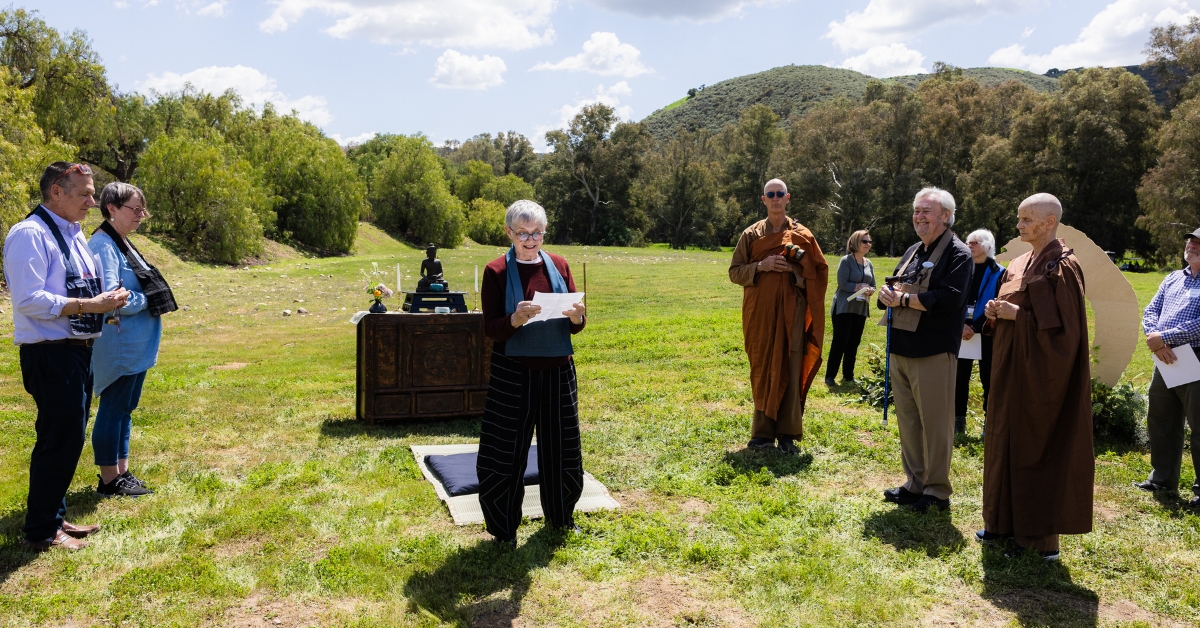
Susan O’Connell and future spiritual leaders at the Enso Verde groundbreaking ceremony
Are there any plans to go beyond Enso Village and Enso Verde, or is it too soon to say?
The ZISL model could definitely work in other settings. We are in the process of clarifying that model in order to be able to partner with other larger entities in the future. ZISL is also supporting SFZC, not only through giving our teachers a place to live but also with financial support.
Another way it benefits the world is that people leave employment here having been trained in conscious aging and they bring that training, those values, with them to their next job. Hopefully this will help spread a way of working with, of being with, the gifts and complexities of aging.
But we can’t do this on our own, we’re not experts in senior living, which is a very complex and highly regulated area. We need other partners.
Any final words?
As practitioners, we’re in the world and we meet the circumstances that arise. This is our job; skillful means is our job. Paying attention, being still enough to hear the winds of change. We hear it, we see it, we smell it. And then with wisdom and compassion, we step forward with our practice offering.
Thank you Susan! How can people contact you?
They can email me at susan.oconnell@sfzc.org