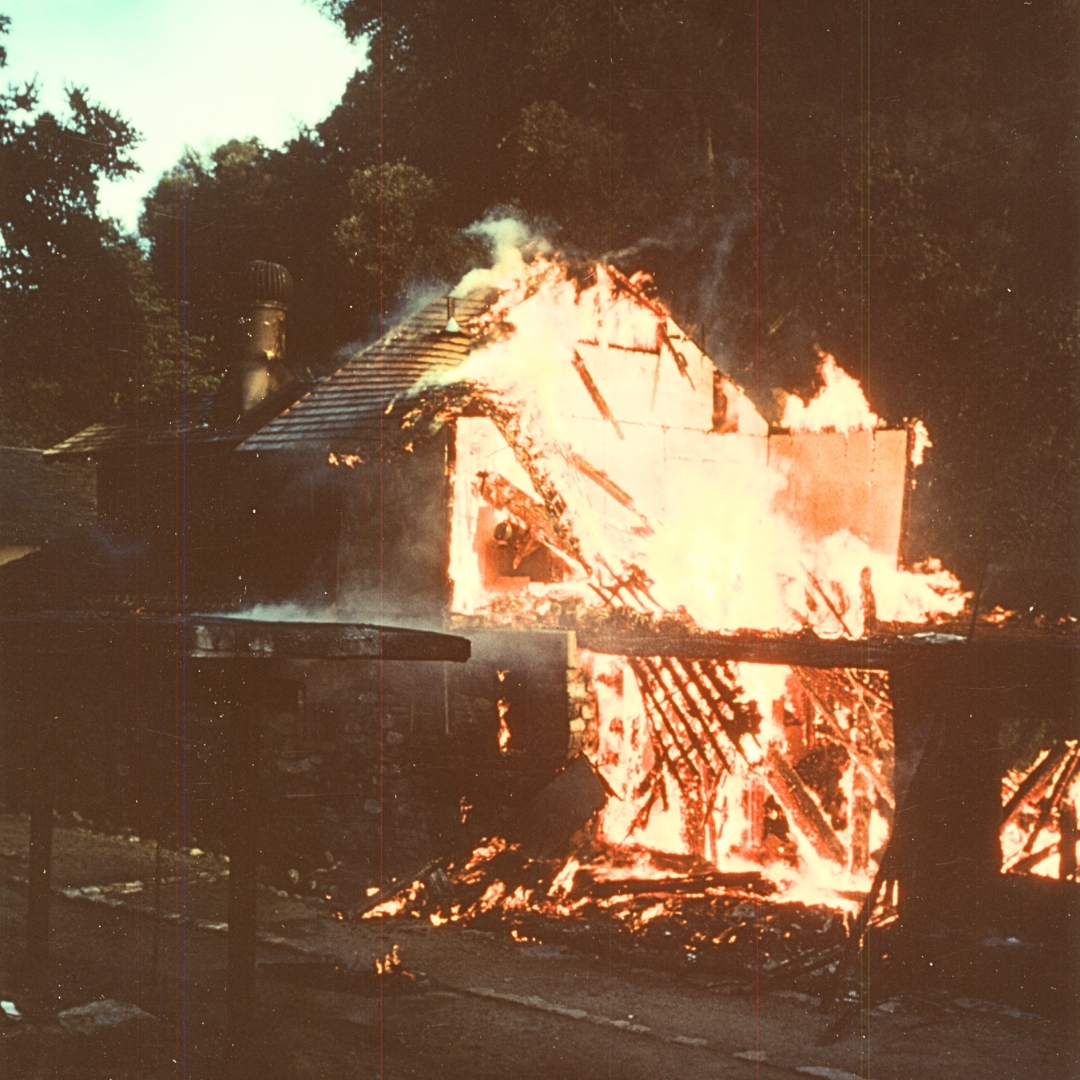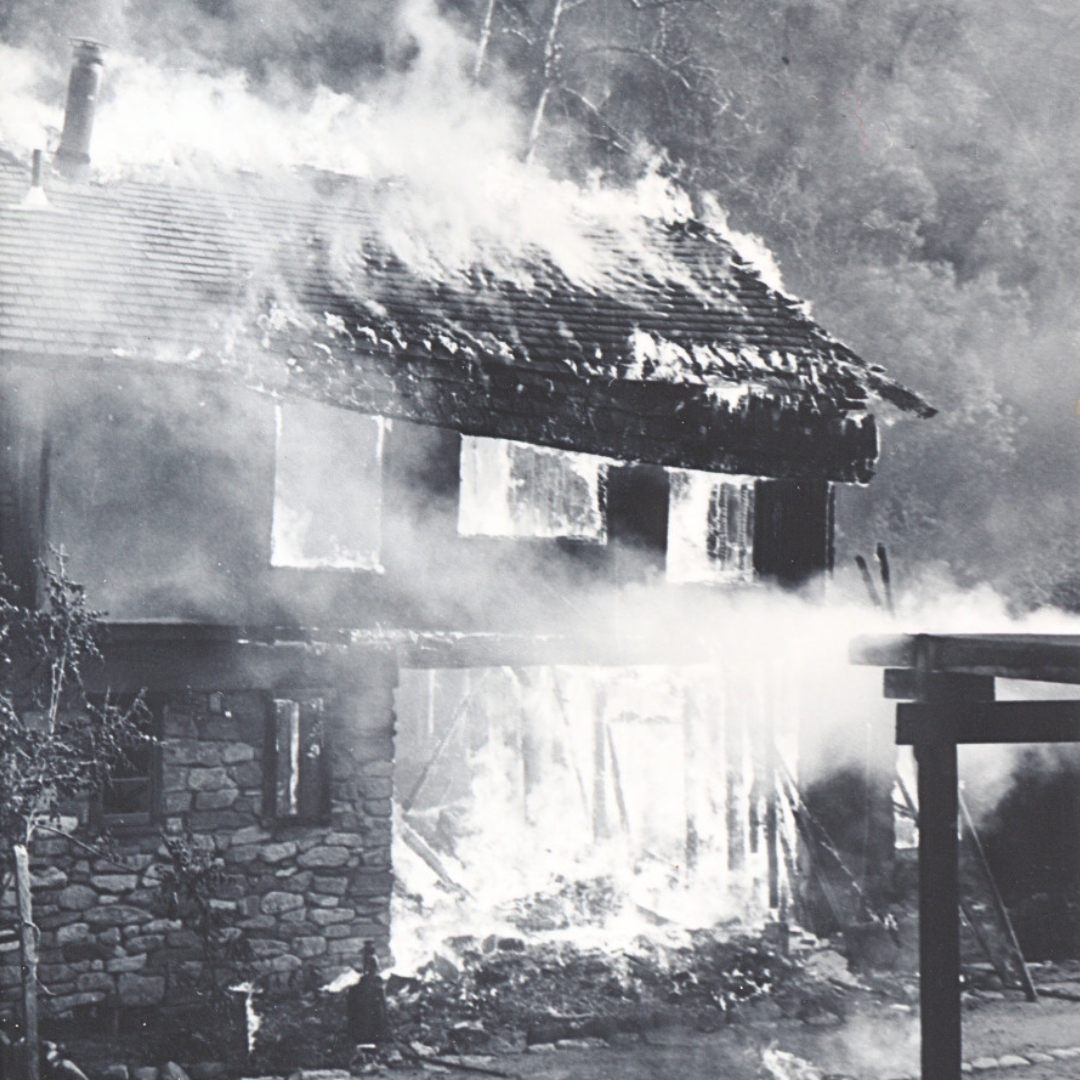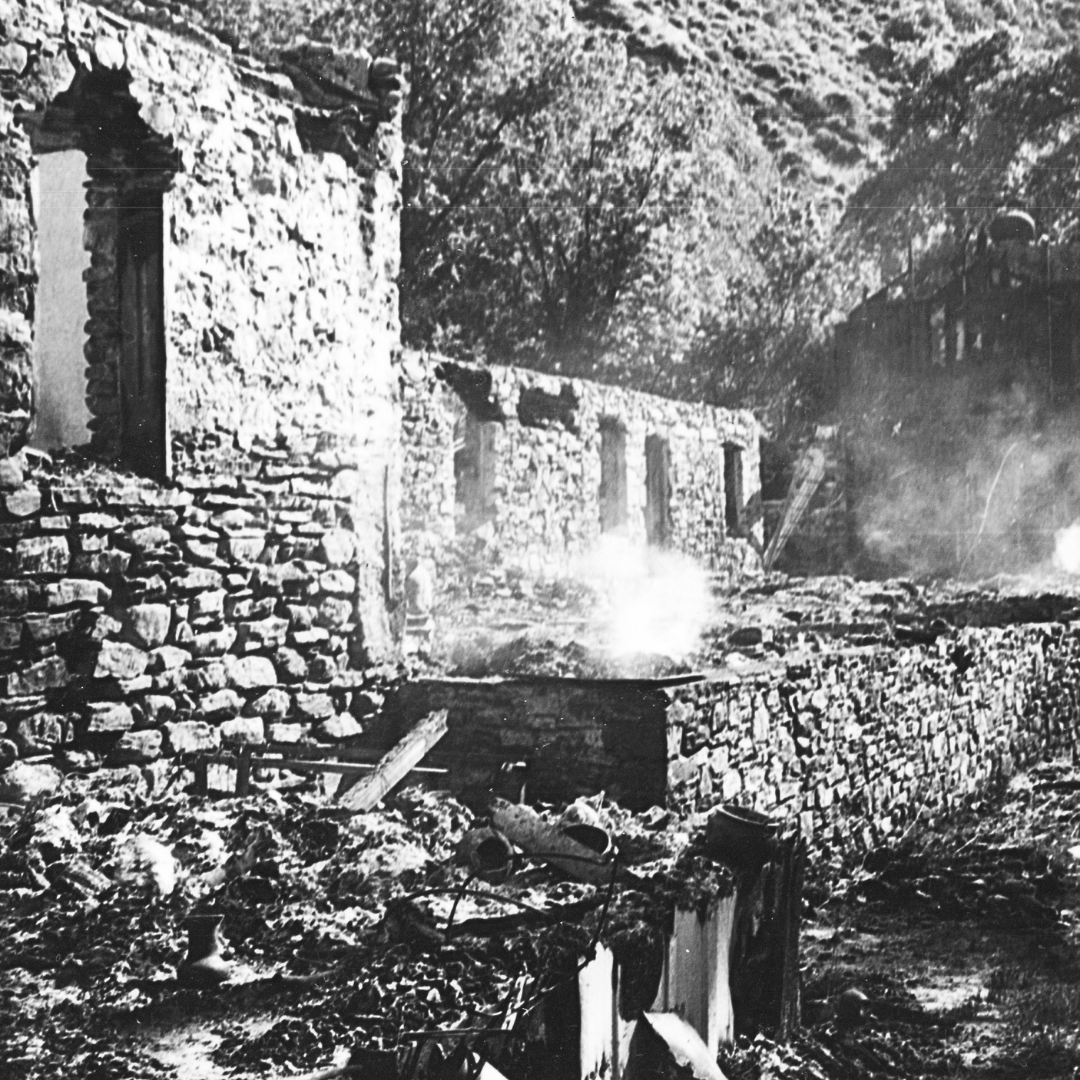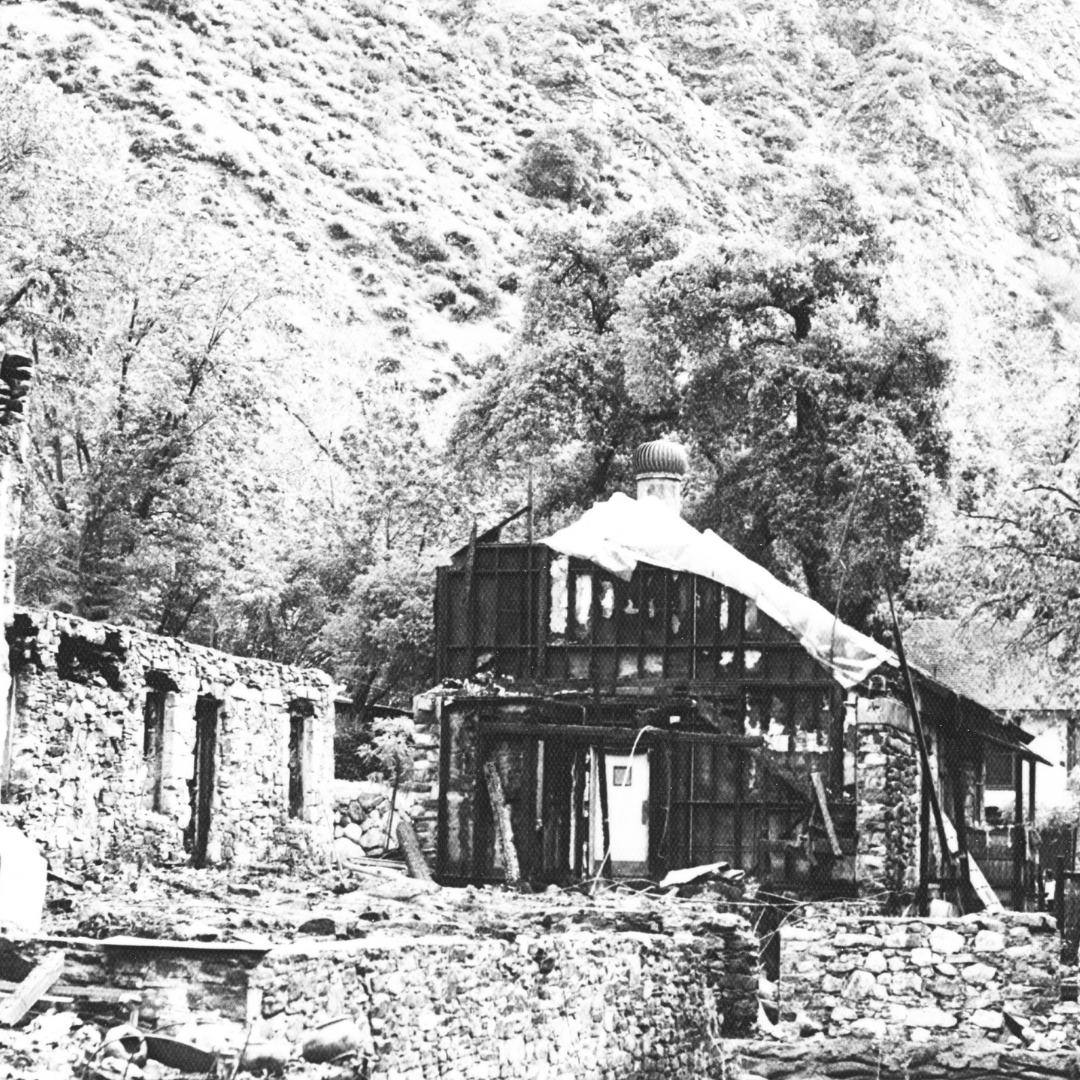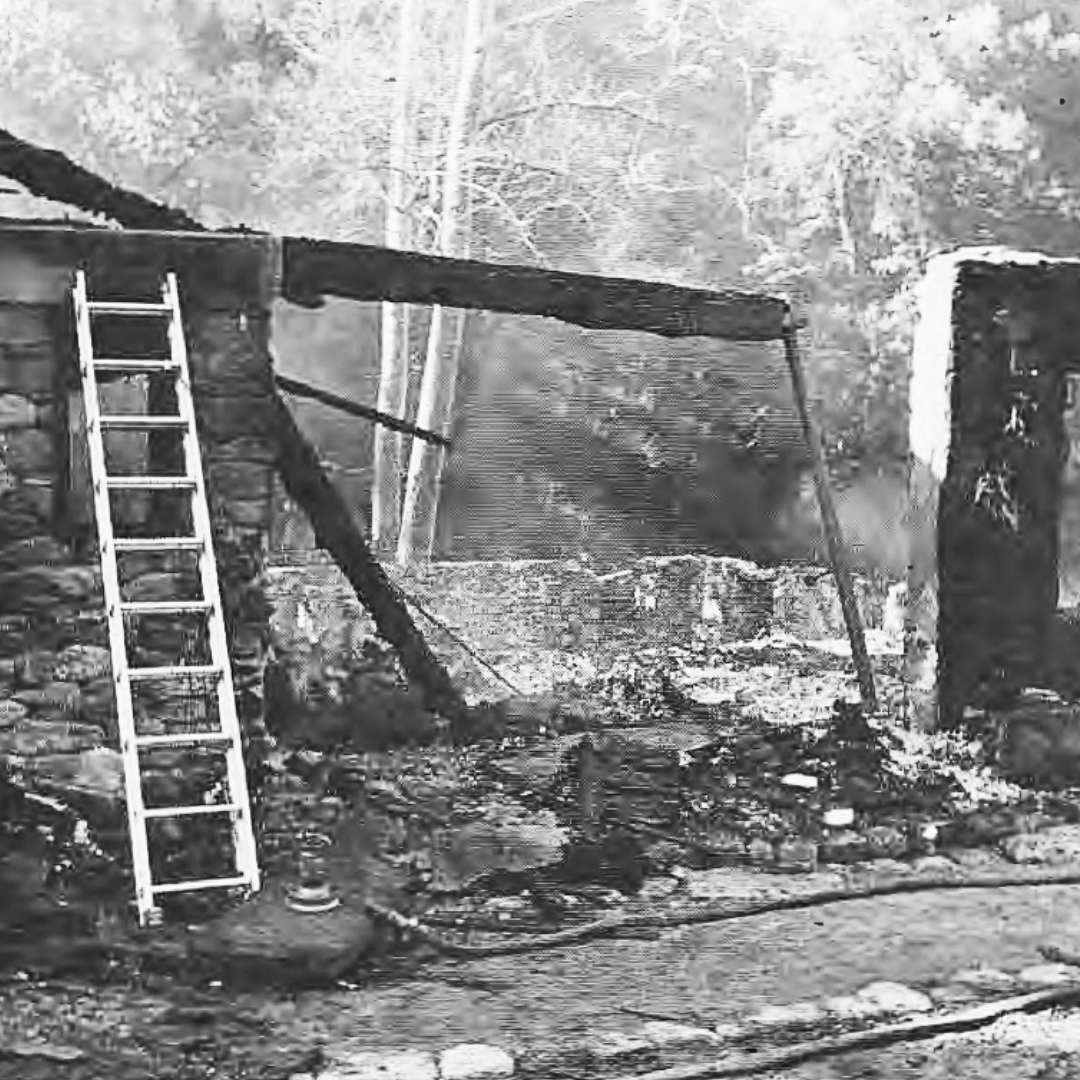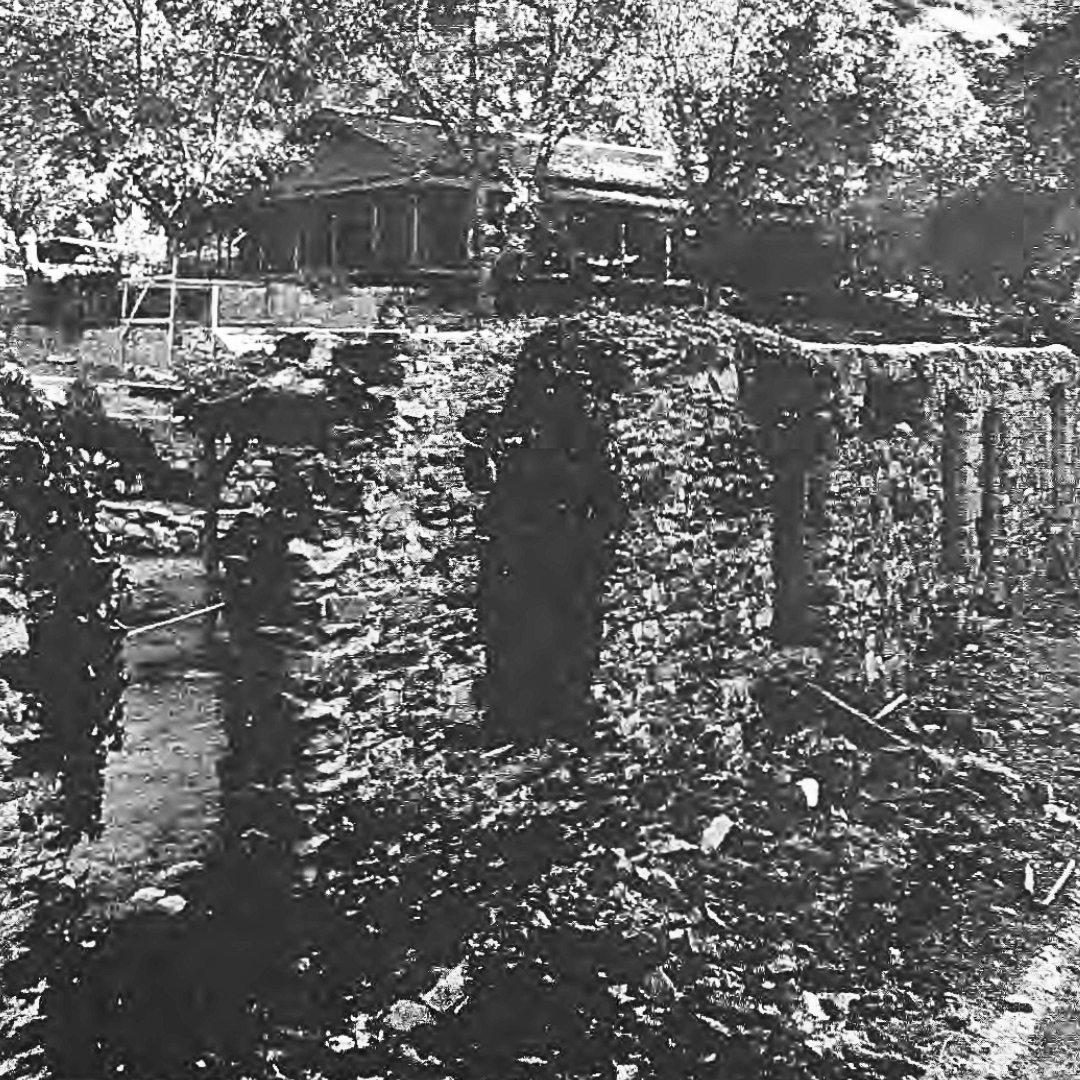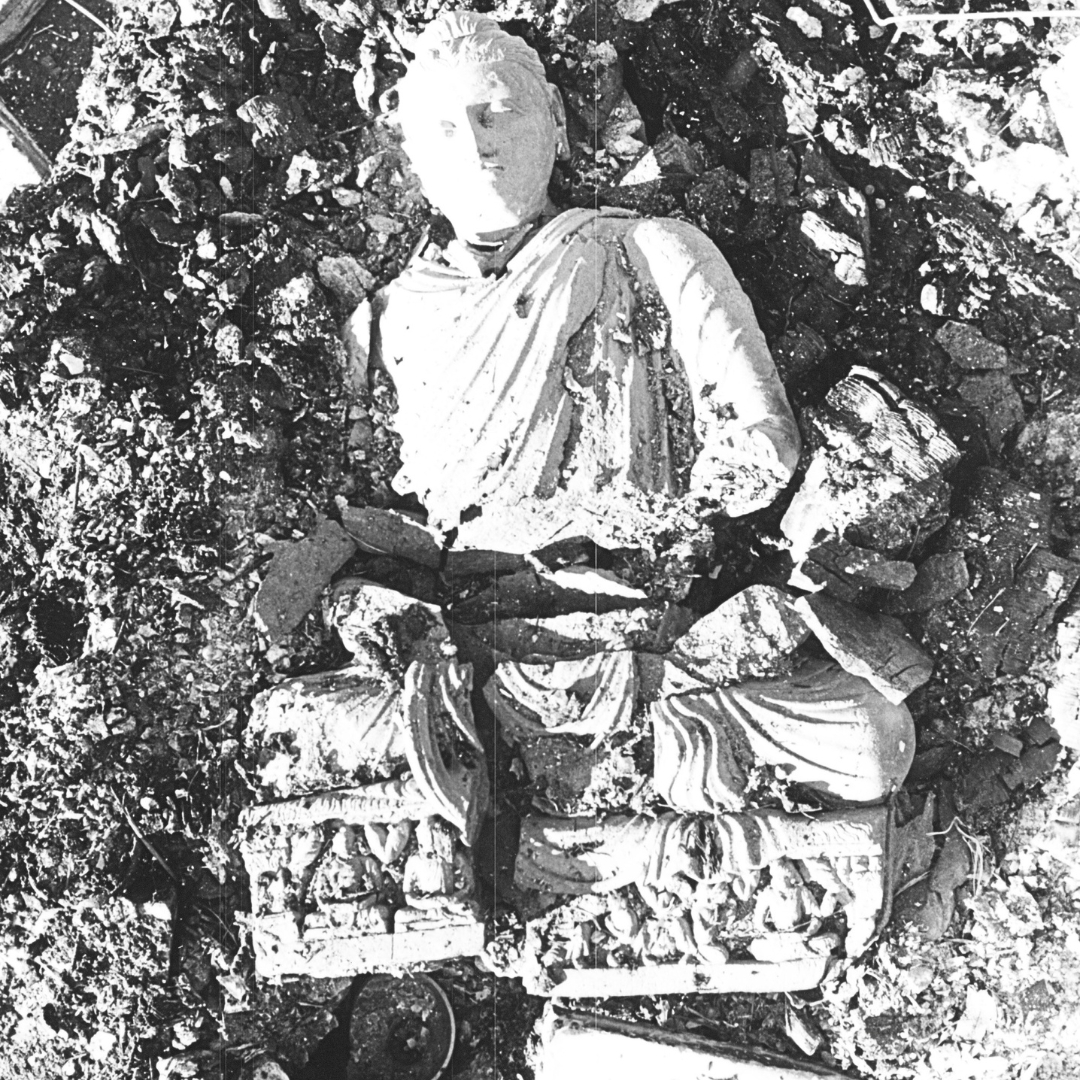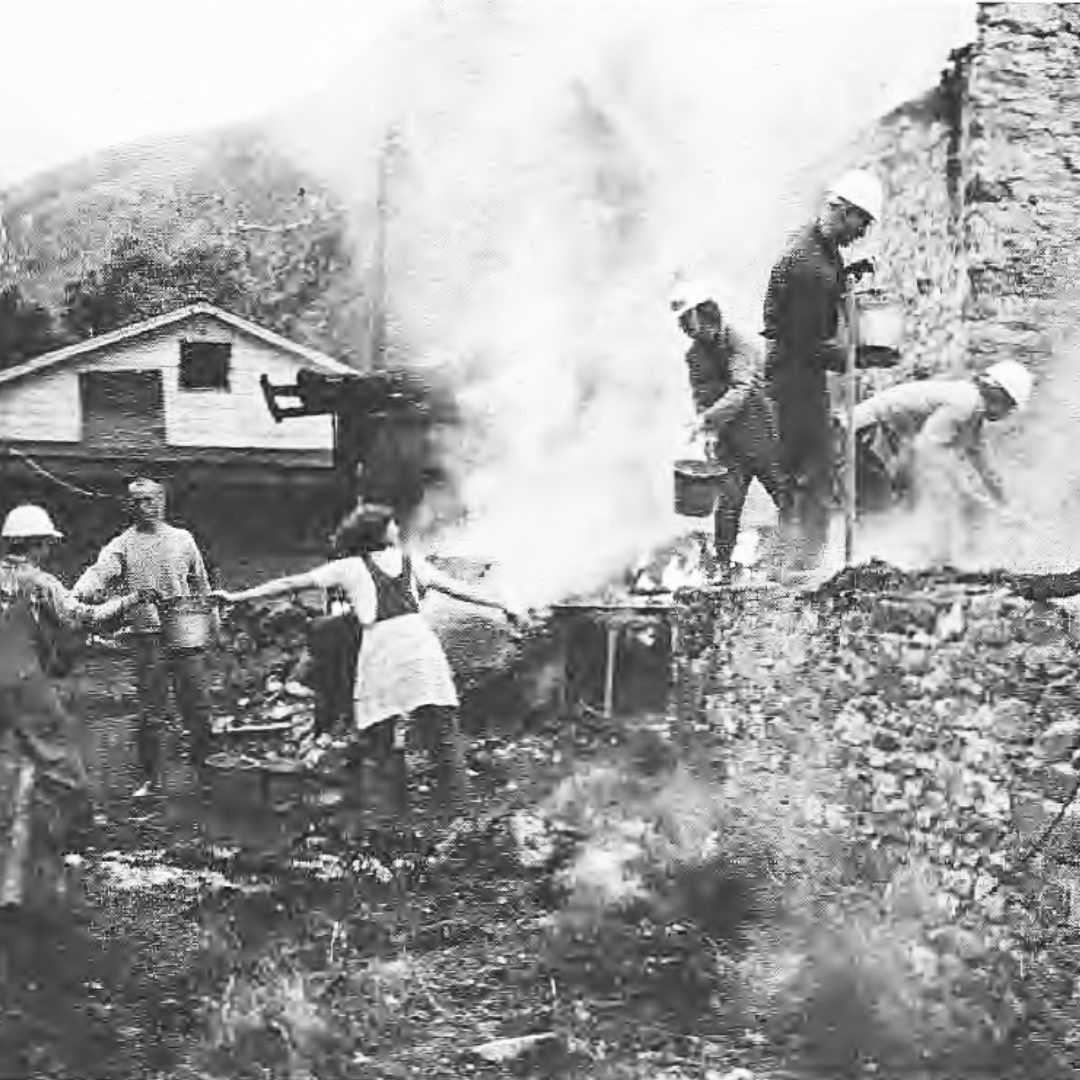

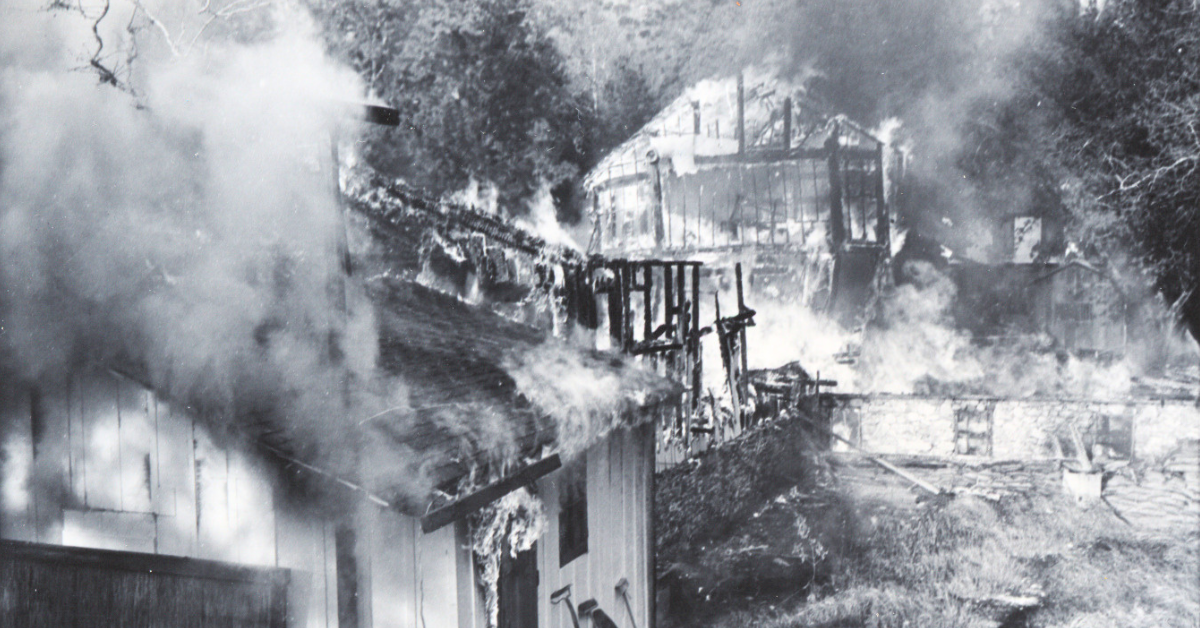
The Tassajara Zendo fire, 1978.
By Rev. Shoren Heather Iarusso
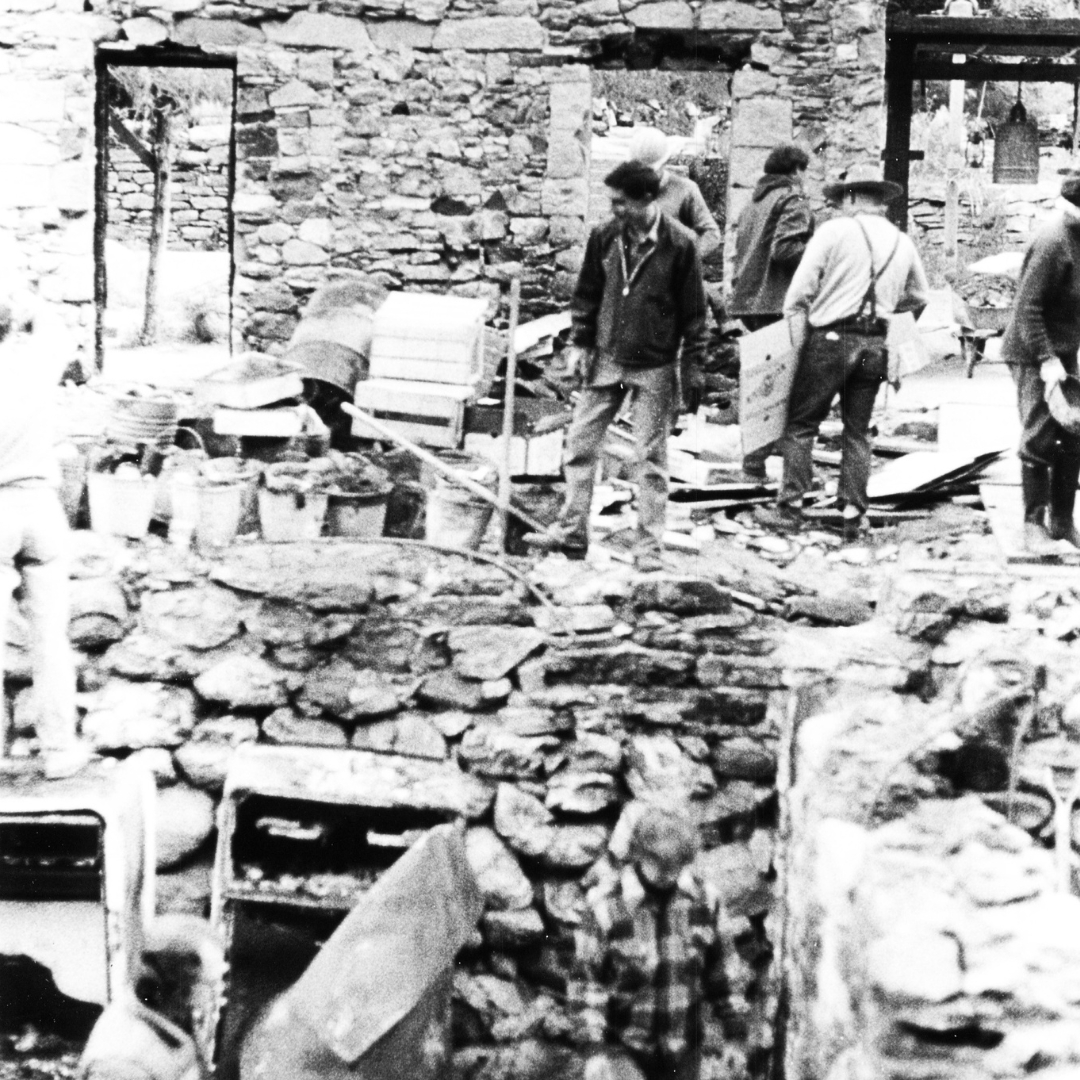
In April 1978, when shouts of “fire!” were heard in the Tassajara zendo, the sangha was participating in a shosan ceremony to mark the end of the practice period. In this ceremony, students are each invited to the front of the room to ask the Abbot a Dharma question.
At the time, the zendo was located creekside, between the kitchen and the Stone Office. “There were 60 people in there,” Keith Myerhoff recalled. “And we were about halfway through the ceremony and when we heard ‘fire’ we thought it was some Dharma thing that was going on. Then we heard, ‘No, no, there’s a real fire.’ And then we all jumped up and by the time the fire got to the back door of the zendo, it was already raging.”
Alan Block was ready with his question, kneeling in choki with anticipation, when he heard the shout. When he turned toward the back of the zendo, he saw someone surrounded by a bright orange glow. Everyone calmly exited the zendo through the side doors, and it was immediately apparent to the trained fire crew that extinguishers were not enough to contain the fire, so they picked up fire hoses.
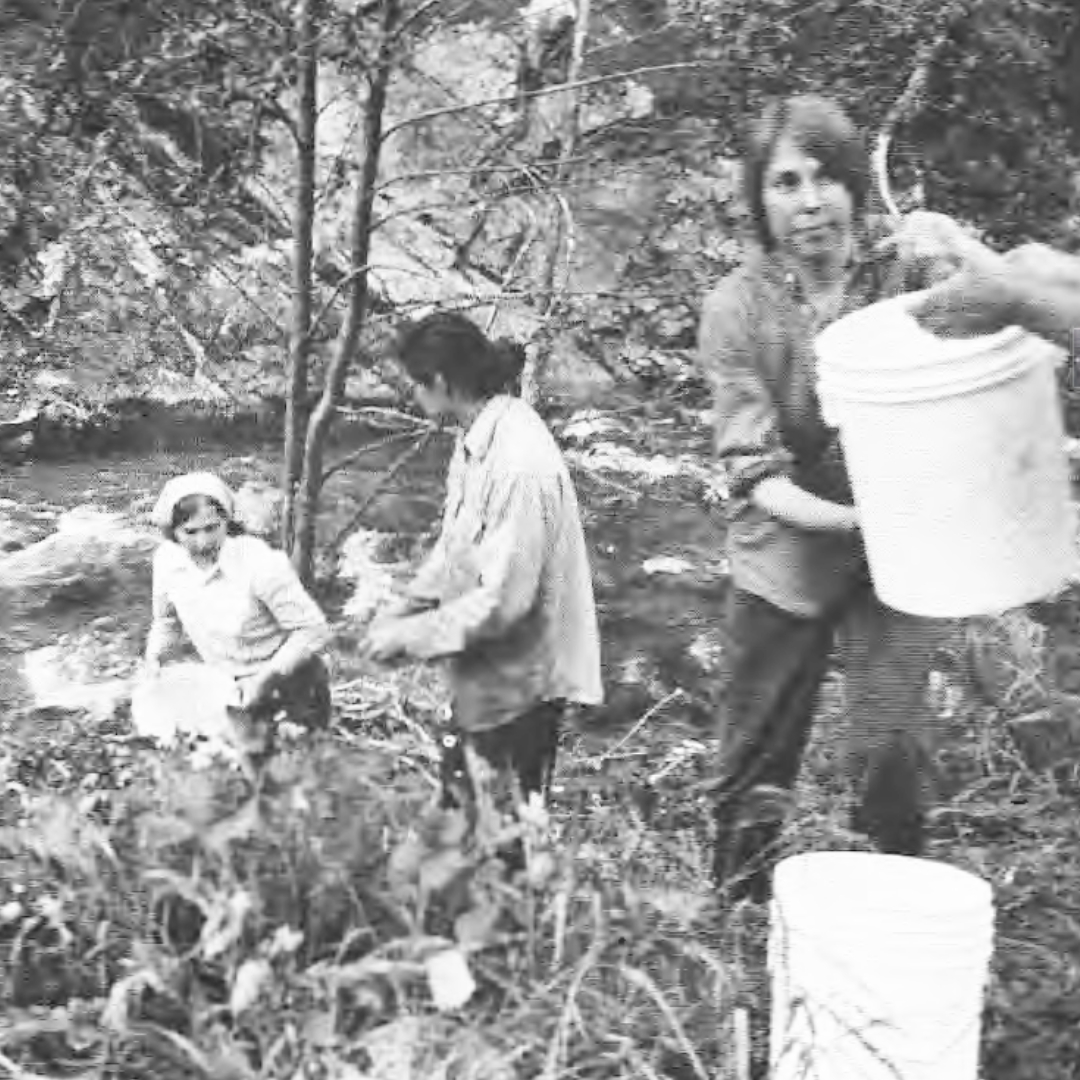
“I grabbed a fire hose and pointed it at the burning building,” Alan recalled. “I felt very unprepared to battle a fire in monastic robes. Unfortunately, the water flow was so weak that it barely traveled a few feet.”
The fire hoses had no pressure because they had been strung through the trees to maintain waterflow after flooding rains had washed out all the water lines. By one person’s account, 81 inches had saturated the monastic valley that winter. This makeshift solution left no pressure in the standpipe system that had been installed years before to battle such fires. Another complicating factor was the large fire pump was broken, and the new one did not arrive until a few days after the fire.
“So all we had was a portable pump on a little raft, and we threw it into the creek and immediately flooded the engine,” Keith said. “People were standing in the creek trying to get the pump to start, and eventually they did and this helped us save the kitchen because the roof was on fire at that point.”
Paul Discoe had spent six years practicing zazen in that zendo with Shunryu Suzuki. When the fire broke out, he was Abbot Richard Baker’s attendant. Paul vividly recalled the scene all these years later.
“ I remember being up on top of the kitchen roof in my robes and zoris (Japanese sandals), and kicking burning shingles off the top of the roof. I don’t know how I got up there,” he said, “because the zoris don’t have a lot of grip, but I was pretty much adapted to them by that time because I had lived in Japan for five years. I hadn’t worn shoes since the late sixties.”
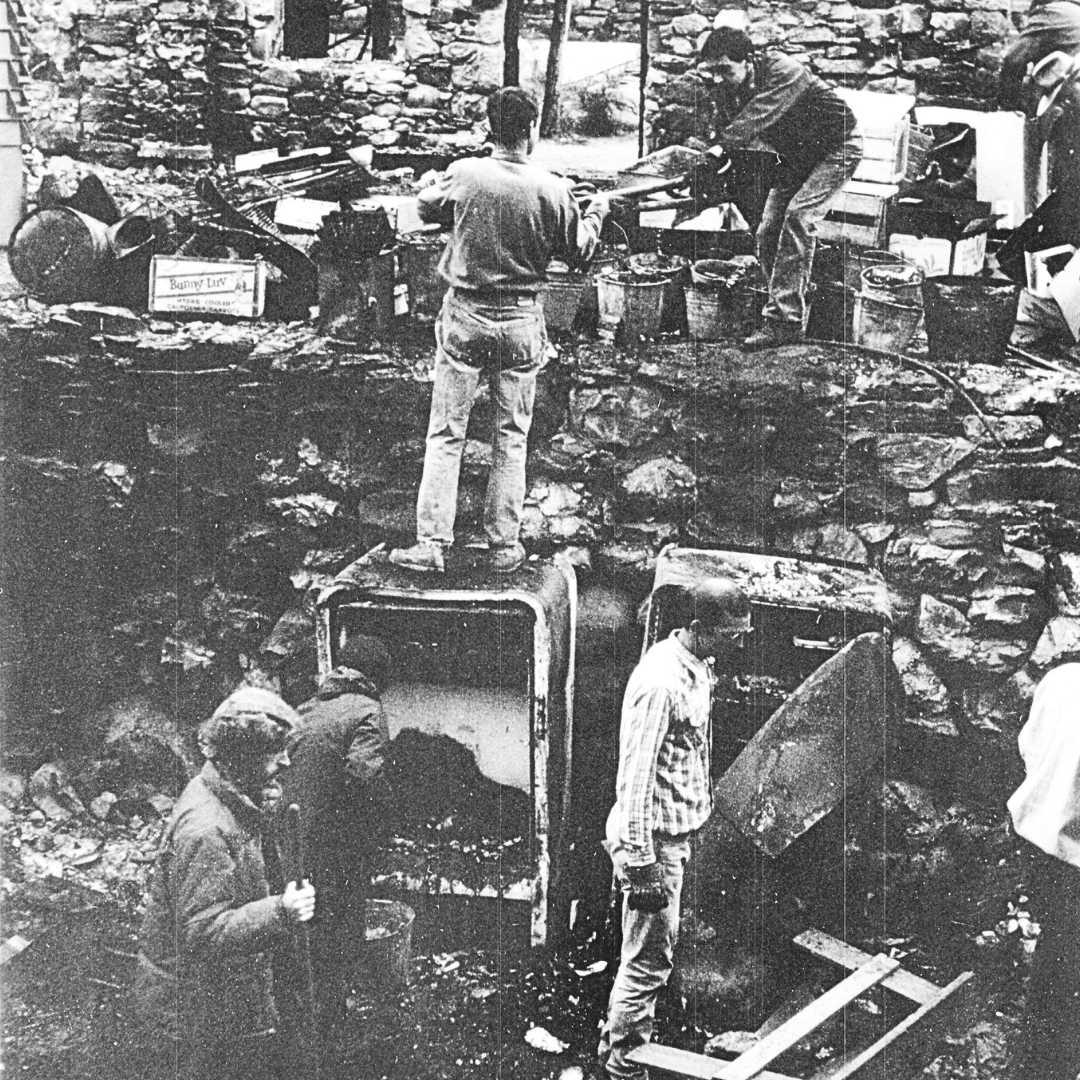
Most people were unable to retrieve their shoes or sandals from the racks outside the door, so they stood barefoot as they watched the flames consume the zendo, the library above the kitchen, the office, and the linen room. According to Wind Bell, the fire most likely started in a propane gas refrigerator in the basement near the zendo.
“All the food burned,” Keith said. “The only food left was what was cooking in the kitchen for the dinner we traditionally had after the shuso ceremony.”
Fortunately, the flames did not spread to the original Pines and Stones rooms; nor did they burn through the one-hour firewall and a fire-resistant door that shielded the adjacent kitchen. The county had insisted that San Francisco Zen Center install this costly fire protection system thinking that if a fire started in the kitchen, it’d stop the flames from spreading.
“People at Tassajara were furious that the county would require this wall and the expensive door because we didn’t have the money,” Alan recalled. “The fire burned right up to that door and scorched it, but did not burn through—thereby saving the kitchen.”
Alan recalled that the day after the fire, with the smell of charred wood and smoke lingering in the air, the sangha resumed the shosan ceremony in the dining room. It was Alan’s chance to ask his question, which had changed because of the fire.
“With clarity, I asked: ‘Why is it that it takes an event like this to remind us how much we love and need each other?’ I think it was what many of us were feeling. I wish I could remember Richard Baker’s answer.”
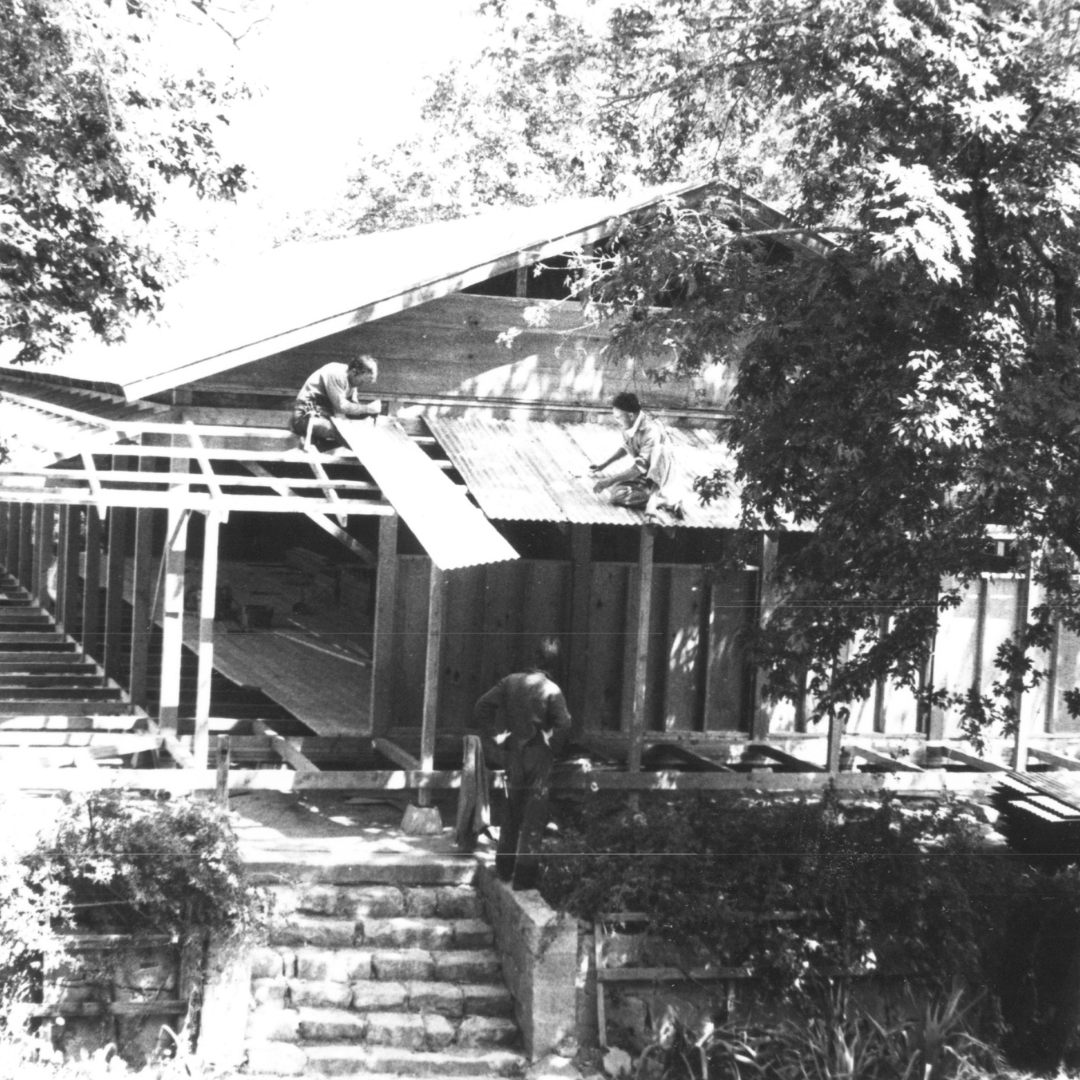
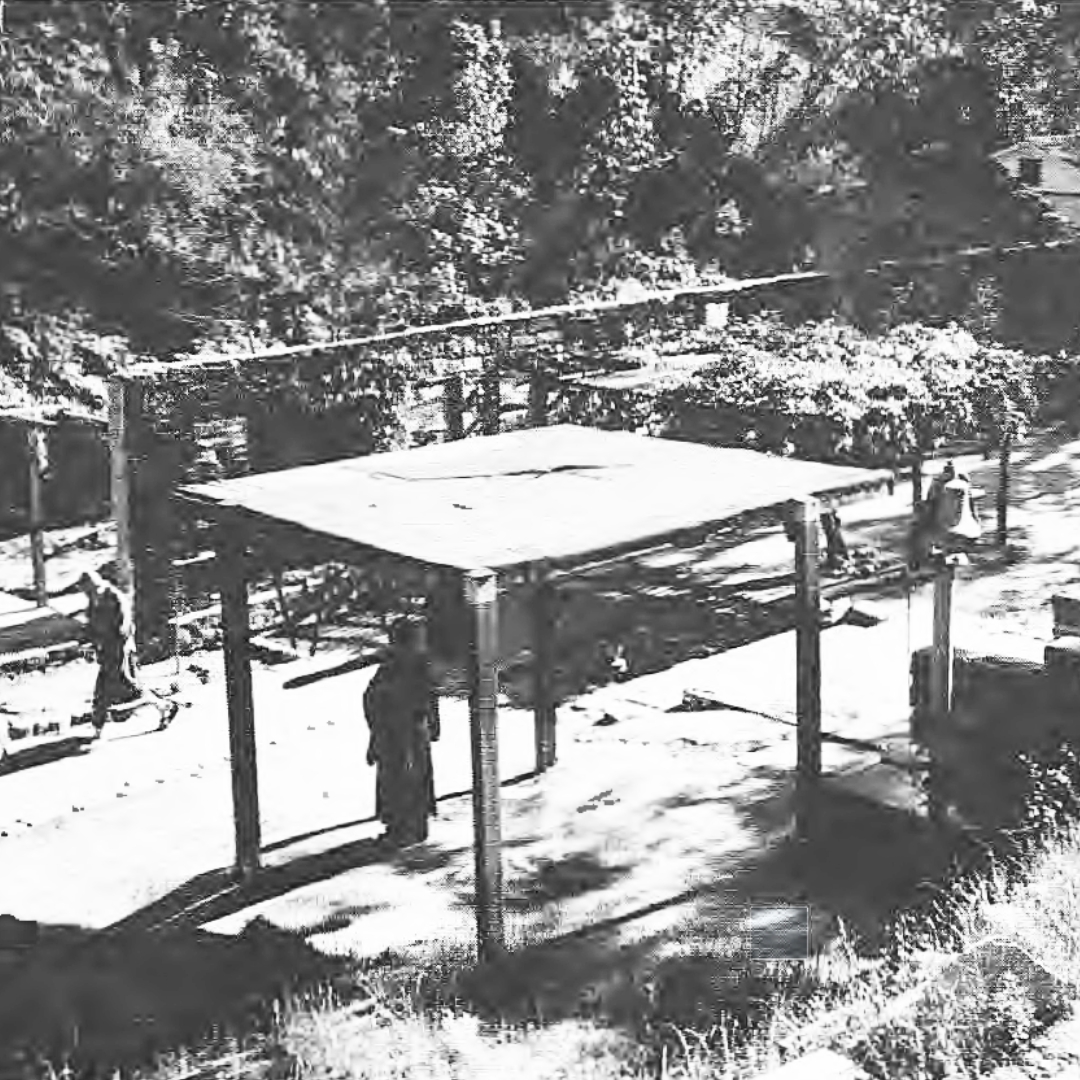
With the zendo gone, the residents began sitting on the porch of the dining room and then they moved to the upper barn in the student housing area which was just an open space at that time. It was decided to build a “temporary” zendo in the southern section of the upper garden, where a two-story stone hotel had once stood before burning in 1949.
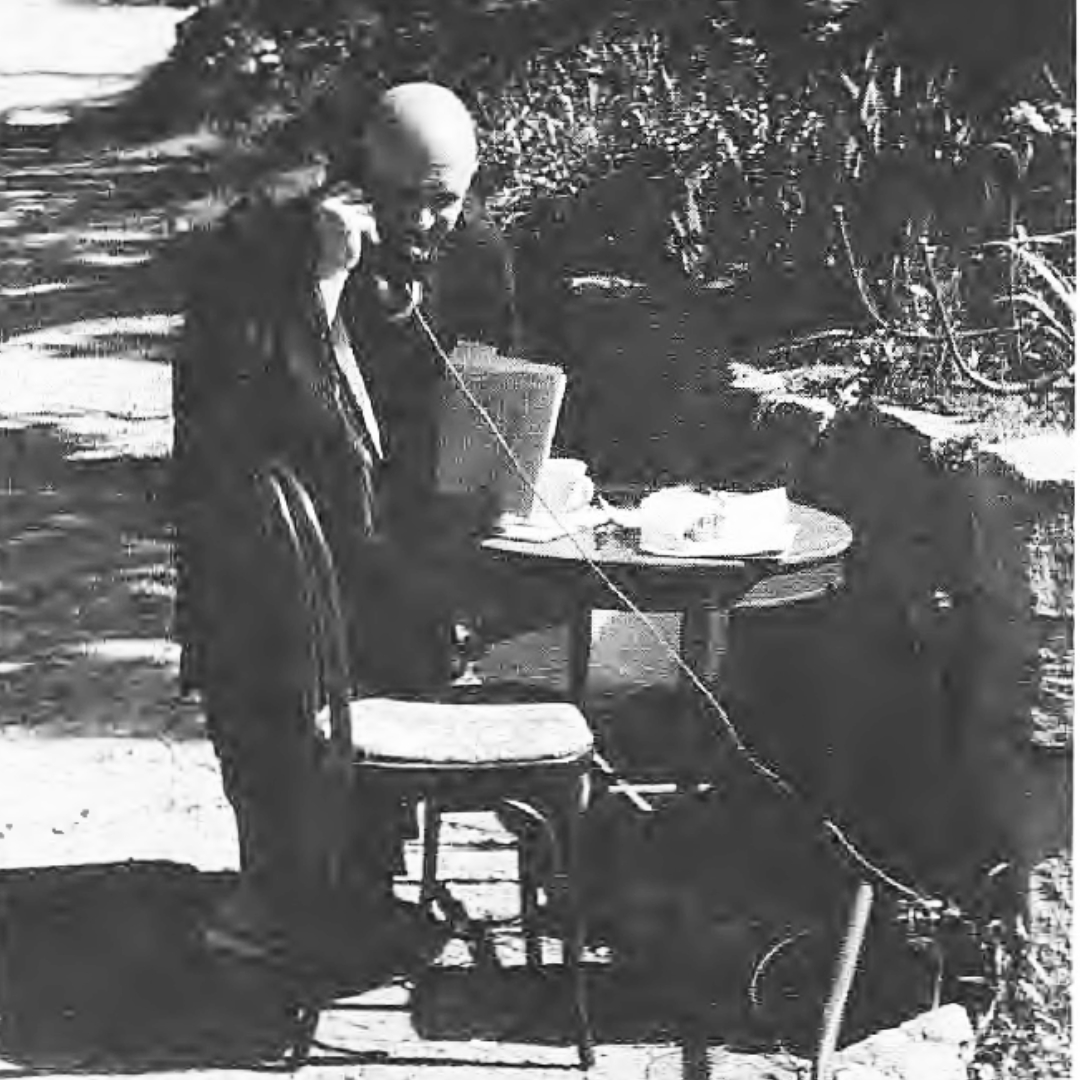
Since the new meditation hall was needed before guest season began, Baker instructed Paul to begin erecting one. However, before Paul could order the necessary materials, he needed a working phone.
“The crank phone mounted on the office wall melted in the fire,” recalled Leslie Meyerhoff. “It was barely a phone even back then. It just had a wire that was strung through the trees and sometimes when you were on a phone call, you could hear the birds that were sitting on the wire.”
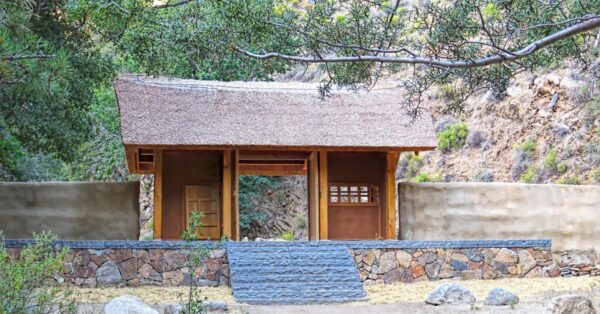
Fortunately they had a portable WW II phone and they threw its electrical wire over the existing one, and Paul was able to connect to an operator. Back then, Paul was not yet a famous and sought-after Zen architect. Over the years he has e designed and helped build the Tassajara entrance gates and the kaisando.
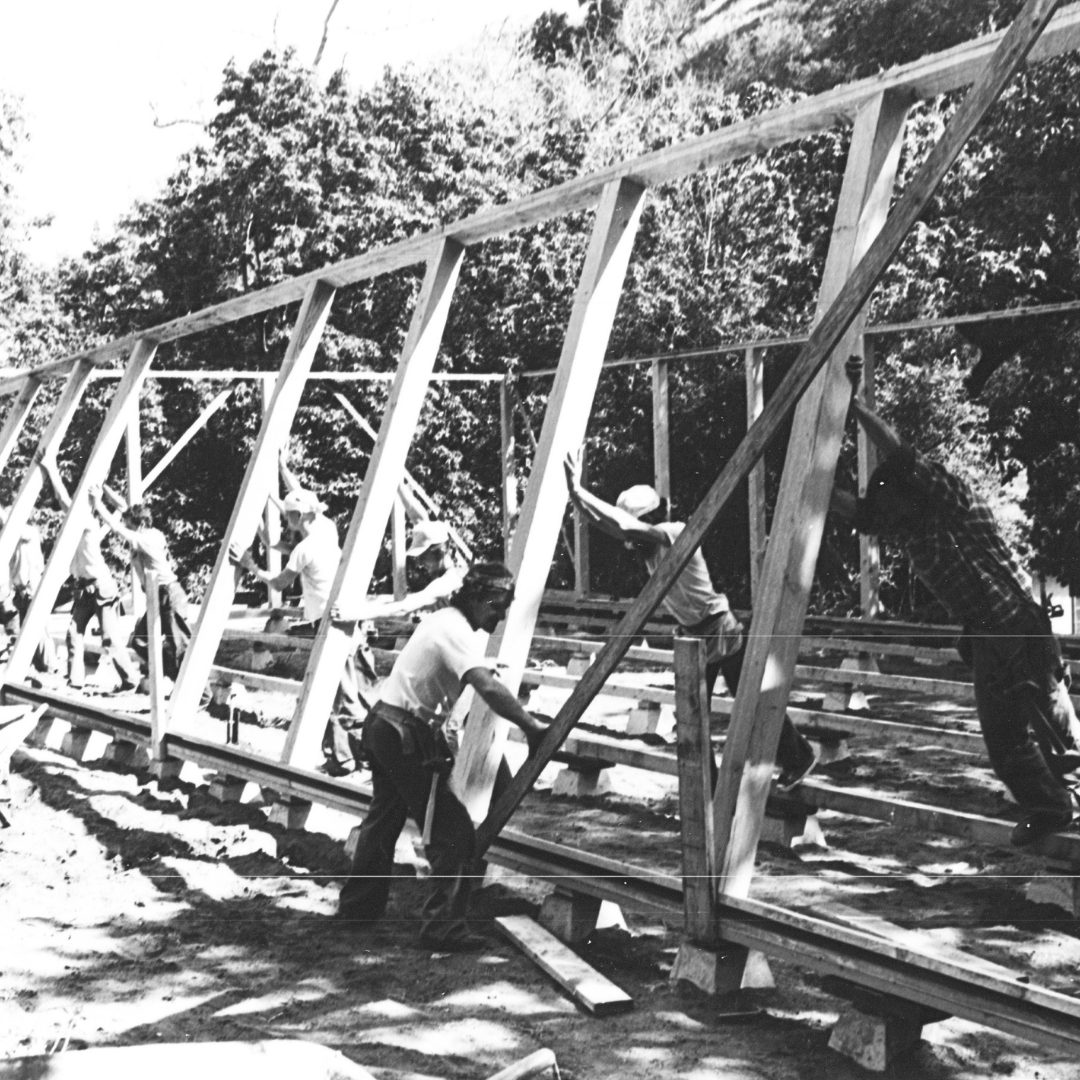
“Paul, our under-appreciated resident genius builder, was in charge and had a clear vision of how the zendo would be constructed,” Alan said. With Paul and Jerry Fuller in the lead, walls were framed on the ground and tipped up. The lumber was inexpensive framing grade, sorted to show the best faces, but essentially rough-grade stock.”
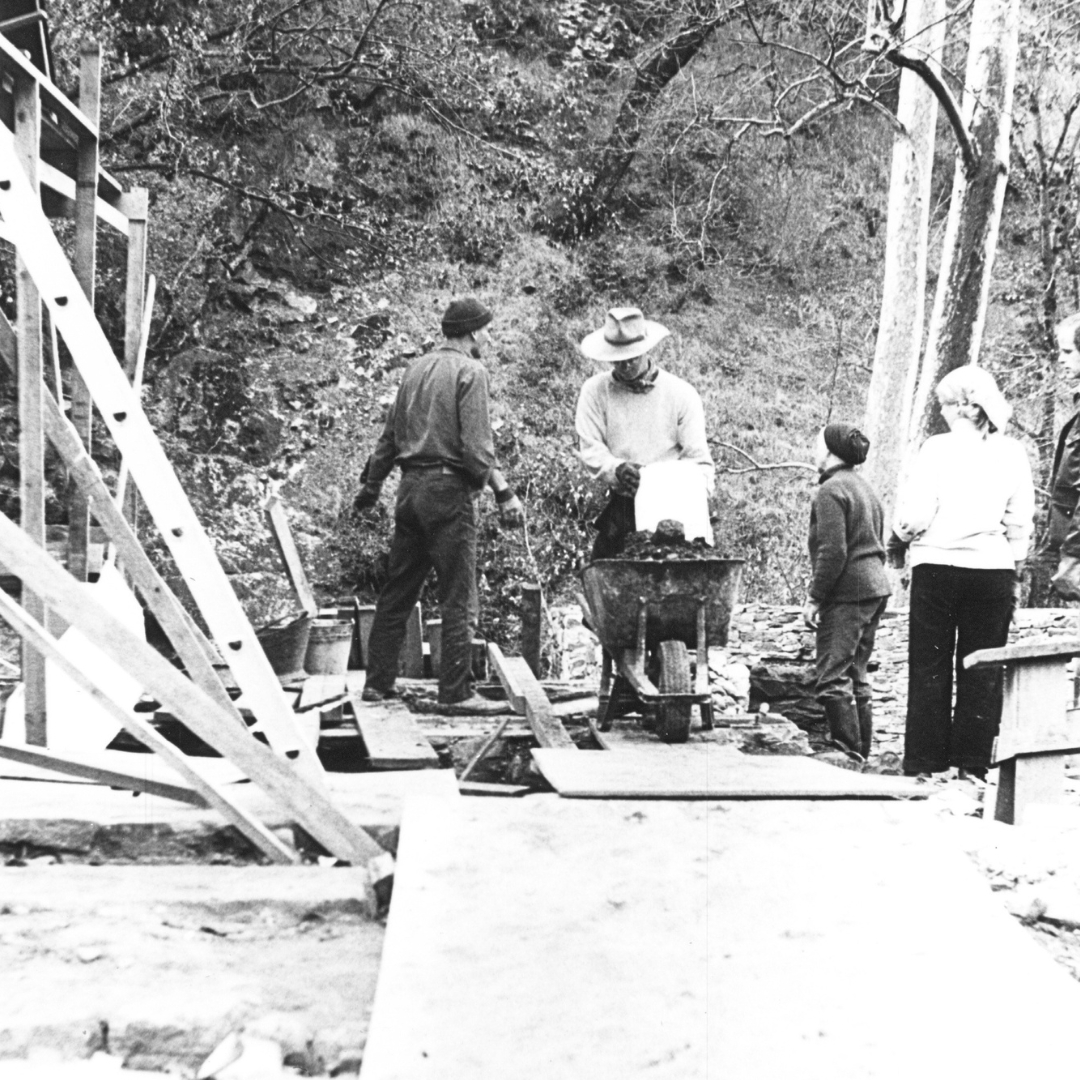
Many volunteers from the Bay Area and beyond contributed their time, effort, and expertise to assist with the construction. The construction crew, however, was mainly composed of Zen students, whose wholehearted enthusiasm made up for their lack of experience. The 1,250-foot structure took roughly two weeks to build and cost about $20,000. Paul used a mix of wood: ponderosa pine for the floor, douglas fir for the frame, and redwood for the outside trim under the shoji screens, and the front and back doors.
Although the building was erected quickly, the design process was precise and thoughtful. Paul employed a hybrid East-West construction approach, utilizing Japanese spatial logic and grid planning, Western nailed construction, and a pier-block foundation rather than poured concrete.
“We had a short amount of time, a short amount of labor, and a short amount of money,” Paul said, “and we needed a space that was not going to interfere with building a permanent zendo. Responding to these limiting factors–the arising myriad things–informed the design, the process, the placement, and the construction.”
Using the teaching of Eithei Dogen’s “Genjo Koan” has been a hallmark of Paul’s architectural design process: being guided by relating with arising causes and conditions rather than forcing a concept onto a project.
“You can’t separate yourself out from your environment,” Paul said. “Your environment has a very large impact on you. My whole practice has been designing buildings with zazen in mind.”
With the “temporary” zendo, Paul wanted its form and space to harmonize with the environment, embody the ancestral Zen tradition, and create a perception of “being outside of ordinary time.”
“One of my strongest feelings of living at Tassajara was the timelessness of it all,” he recalled. “You’re isolated from the outside world, at the end of a long mountain road, surrounded by intense nature, and there’s a profound feeling of timelessness––that the space itself does not feel fixed in time.”
***************************************
From the editor:
For 48 years this ‘temporary zendo’ stood strong and vital, housing hundreds if not thousands of students, teachers, and summer guests as they discovered and deepened their sitting practice, bowed and chanted in service, learned forms, ate formal meals, and listened to the Dharma. In March of 2026, the zendo caught fire and burned so thoroughly that the exact cause of the fire will never be known, although likely it was electrical and started in the attic.
As we start the process of recovering from the fire, we are faced with the realities of a much different era. With challenges like stricter building codes and permitting, cost of goods, and escalating insurance costs, our new zendo will not be built in two weeks, nor will it cost only $20,000. But the spirit and commitment of the sangha coming together to make it happen is stronger than ever. There are many questions to answer and problems to solve in the coming months, but still, as the Buddha said when he planted a single blade of grass on a patch of dried earth, “This is a good place to build a sanctuary.”
***************************************
This article was updated on May 28 to reflect the fact that Paul Discoe did not design and build the dining room and upstairs dorm.