
By Heather Shōren Iarusso
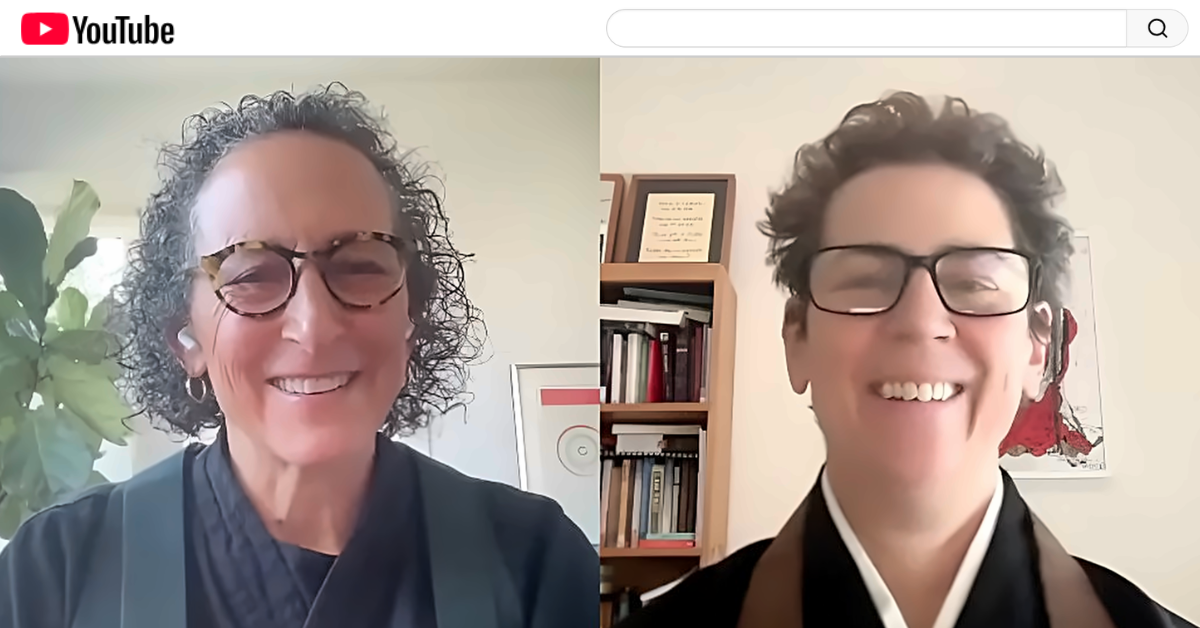
Heather: We’re here to talk about the online course you’re offering called Diving Deep into Zen, starting on April 12th. Why don’t you begin by telling us about yourself and your practice of Buddhism?
Pam: I’ve been practicing for 30-plus years. I came to [San Francisco] Zen Center in my twenties and stayed for almost 15 years, living at Green Gulch and Tassajara. I left Zen Center to get married and start a business. I became a stepmom and lived fully in the world.
About 10 years ago, I completed Dharma Transmission as a layperson, which was a first for San Francisco Zen Center. I’ve also been trained and authorized in the Insight Meditation tradition. So I teach long meditation retreats in the Insight tradition, and I also teach in Zen.
This course brings those two pieces together and taps into my nerdy, historical love of these teachings and my desire to bring them alive.
A big part of my motivation is to take teachings that people often find confusing, esoteric, or even intimidating, and make them accessible—to bring them out of the head and into the body and heart so they become living teachings.
As a layperson especially, I wanted teachings that made sense in the context of everyday life. That’s a big focus of the course: application. How do these teachings help us in the midst of the world we’re living in right now? Integration and application are very important to me. And there’s also plenty for people who, like me, love the historical details and want all the background.
The course is structured so that each month we focus on a topic. There are two sessions: a longer one at the beginning of the month and a shorter one two weeks later. I give a Dharma talk and offer resources like articles and background reading—some people love that; others less so. [laughs] Then I offer specific practices for each teaching. That’s where people bring the material out of their heads and into their bodies and lives. That part is deeply satisfying and actually fun.
The final piece is interactive inquiry. Participants don’t just listen to talks or read materials—they learn how to explore, in an embodied way with other practitioners, how the teachings land for them. What does this mean to me? What confuses me? What insights are arising? There’s a strong relational, interpersonal dimension to the program, and that’s often people’s favorite part. There’s so much hunger not just to read about something, but to chew on it, digest it, and engage with others.
Heather: I think that’s such an important part of practice—the application. Sometimes a teaching doesn’t resonate intellectually. But when we begin to enact a practice, embody it, and learn more about the teaching and the person we’re working with, it really comes alive. The sangha is the third jewel, and now we have the good fortune of being able to practice digitally with people from around the world. This online sangha is a wonderful aspect of technology.
I’m curious how you chose the teachings you’re focusing on for this eight-month class. You’re covering the three characteristics, dependent origination, emptiness, the two truths—how did you decide on these particular teachings of the Buddha and subsequent ancestors?
Pam: The simple answer is that these are some of my favorites. More broadly, I wanted to bring forward teachings that often feel gnarly, tangled, confusing, or even frightening for people, and help them make sense and come alive.
During the study portion of my Dharma Transmission process—which wasn’t eight months but two years—we went all the way back historically and traced the key teachings that underpin the Soto Zen lineage we practice. It was incredibly illuminating. I began to see, “Oh, that’s why we do that. That’s where that comes from.” Suzuki Roshi didn’t make this up. Dogen didn’t make this up. These teachings have deep and beautiful historical roots.
So I chose teachings that begin with foundational Theravada material—not the Four Noble Truths or the Eightfold Path—but starting with the three characteristics. Then we move into dependent origination, which many people find difficult. From there we explore emptiness, Nagarjuna, Vasubandhu and the nature of mind, and then awakening—what is awakening? The final piece returns to application: bringing everything out of the head and into the body and into our lives.
It’s dynamic. Some people find it a lot to take on, but I teach in a way that offers multiple doorways. Some prefer study; others want to work more directly through meditation, chanting, or interpersonal practice. All those options are available, so people can discover their own relationship to these beautiful teachings.
You asked about where practitioners sometimes get stuck. I can’t speak for everyone, but for me, I was once a little overzealous in thinking Soto Zen—Suzuki Roshi’s Zen—was the best teaching, and I kept blinders on to other traditions. I regarded them as somehow second-class.
Through deeper study, I’ve come to appreciate how rich and complementary the broader teachings are. They illuminate and bring depth to the uniqueness of our path. This kind of study can help open things up rather than keeping practice narrow.
It’s also especially helpful for people who already have an established meditation practice. That prevents the teachings from remaining merely cognitive or intellectual. These are liberative teachings. The orientation of this class is to engage them in a way that helps free us—so we can respond to the cries of the world, which are very loud right now. Zazen is essential to that, but it’s not the only piece.
Heather: I really feel the value of bringing the wisdom aspect—what we might call knowledge—into our practice. Meditation informs our understanding of teachings, and teachings inform our meditation. Dharma inquiry often arises naturally for me when I’m sitting.
There’s something about widening our field of knowledge and practice that feels essential for meeting the cries of the world. How do we walk the path day by day with more liberation and space in our hearts and minds—for ourselves and others?
Pam: There’s a paradox here. On one hand, we’re opening beyond just sitting or only reading Zen Mind, Beginner’s Mind or Dogen. We’re exploring the roots of the teachings. On the other hand, the structure of this course provides focus. Each month we concentrate on one dimension of the teaching. When we take something on in a focused way, it reveals itself. If we try to take on too much, it becomes noise. But when we focus deeply on one thing at a time, it illuminates.
Then we begin to see how everything connects—like a string of pearls. This connects to that, and that connects to the next. Eventually, we see the whole necklace—a full view of this gorgeous set of teachings we find ourselves in the midst of.
Watch the full interview here.